
When I continued saying that we were going to win against communism by peaceful means, they looked at me like a madman.
Lech Walesa was born in Popowo, Poland. His father died shortly after World War II; he and his brothers and sisters were raised by their mother, aunt and uncle. The Soviet Union occupied Poland after the war, and the Soviet-imposed communist government controlled almost every aspect of life in Poland, except for the Catholic Church.
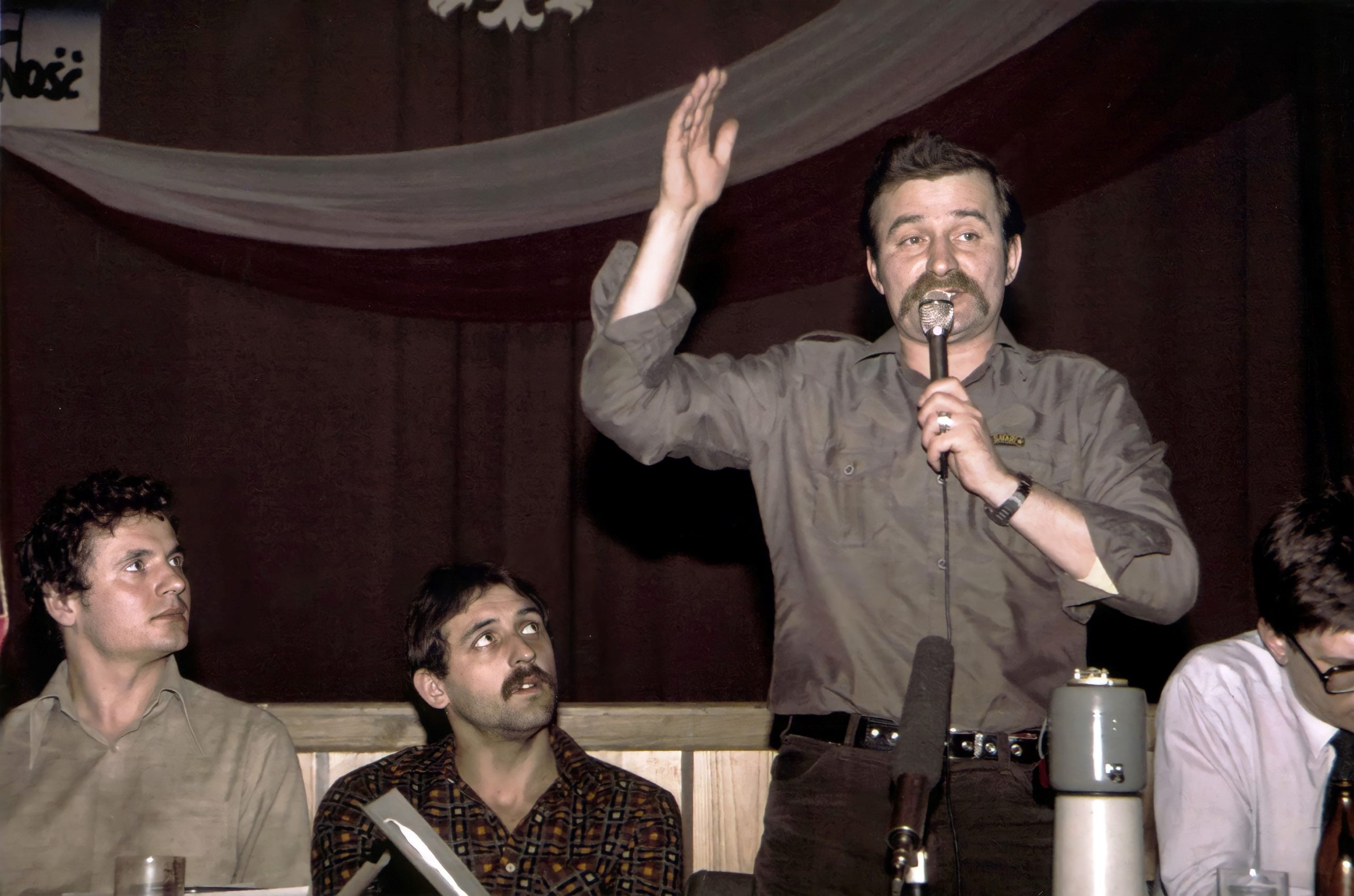
Walesa trained as an electrician and mechanic, and as a young man went to work at the Lenin Shipyard in Gdansk. Walesa was an outspoken critic of the shipyard management and of the communist regime. He was involved in the shipyard strike of 1970, and throughout the next decade played a role in organizing the shipyard protests. In 1976 he was fired for his political activities. Although he was only sporadically employed for the next four years, he persisted in his organizing.

In 1980, the shipyard workers were ready to strike again, and Walesa emerged as a leading spokesman of Solidarity, the first independent trade union in the Eastern Bloc. A series of strikes spread throughout the country, forcing the government’s recognition of Solidarity, but this victory was short-lived. When Solidarity called for free elections, the government outlawed the union. Fearing Russian military intervention, Poland’s puppet government declared martial law in December 1981. Walesa was arrested and held for months without trial. When he was finally released in September 1982, he remained under government surveillance.

The outside world recognized Walesa’s courage, and he was awarded the Nobel Prize for Peace in 1983. The encouragement of the Polish-born Pope John Paul II kept Solidarity’s hope alive underground, and the ascension of reform-minded Mikhail Gorbachev in the Soviet Union presented another opportunity for the Polish dissidents to press their case.

By 1989, Gorbachev had made it clear that he would not intervene to prop up communist governments in Eastern Europe. Nationwide protests at last forced the communist regime to hold free elections, and Solidarity quickly formed a new coalition government. Walesa traveled to the United States, accepting a Presidential Medal of Freedom from President George H.W. Bush. In a ceremony in the East Room of the White House, before Congressional leaders and Polish-American guests and labor leaders, President Bush hailed Mr. Walesa as “the spiritual godfather of a new generation of democracy.” President Bush said, “you were called a ‘nobody,’ but Lenin and Stalin have been disproved not by Presidents or Princes but by the likes of an electrician from Gdansk and his fellow workers in a brave union called Solidarity. The Iron Curtain is fast becoming a rusted, abandoned relic, symbolizing a lost era, a failed ideology.” Lech Walesa went on to become the first non-head of state to address a joint session of the United States Congress.

In 1990, Lech Walesa was elected to a five-year term as President of Poland. His autobiography, The Struggle and the Triumph, first appeared in English in 1992. Walesa supported the policy of “shock treatment” to convert Poland’s socialist economy to a Western capitalist model. A devout Catholic, he followed the Church’s teachings on matters of social policy, and in 1993 signed a controversial law virtually outlawing abortion, which had been permitted in Poland since the 1950s.

Walesa narrowly lost his bid for re-election to the presidency in 1995, losing to the former communist Alexander Kwasniewski. The following year he founded a think-tank, the Lech Walesa Institute, to support the development of local governments in Poland and of democracy throughout the world. In 1997 he helped organize a new political party, Christian Democracy of the Third Polish Republic. He ran for the presidency a third time in 2000, but captured only one percent of the vote, finishing seventh in a field led by the former communist Krasniewski. While this was effectively the end of Walesa’s political career, he remained a highly visible figure in Polish public life and lectured around the world on Central European history and politics.
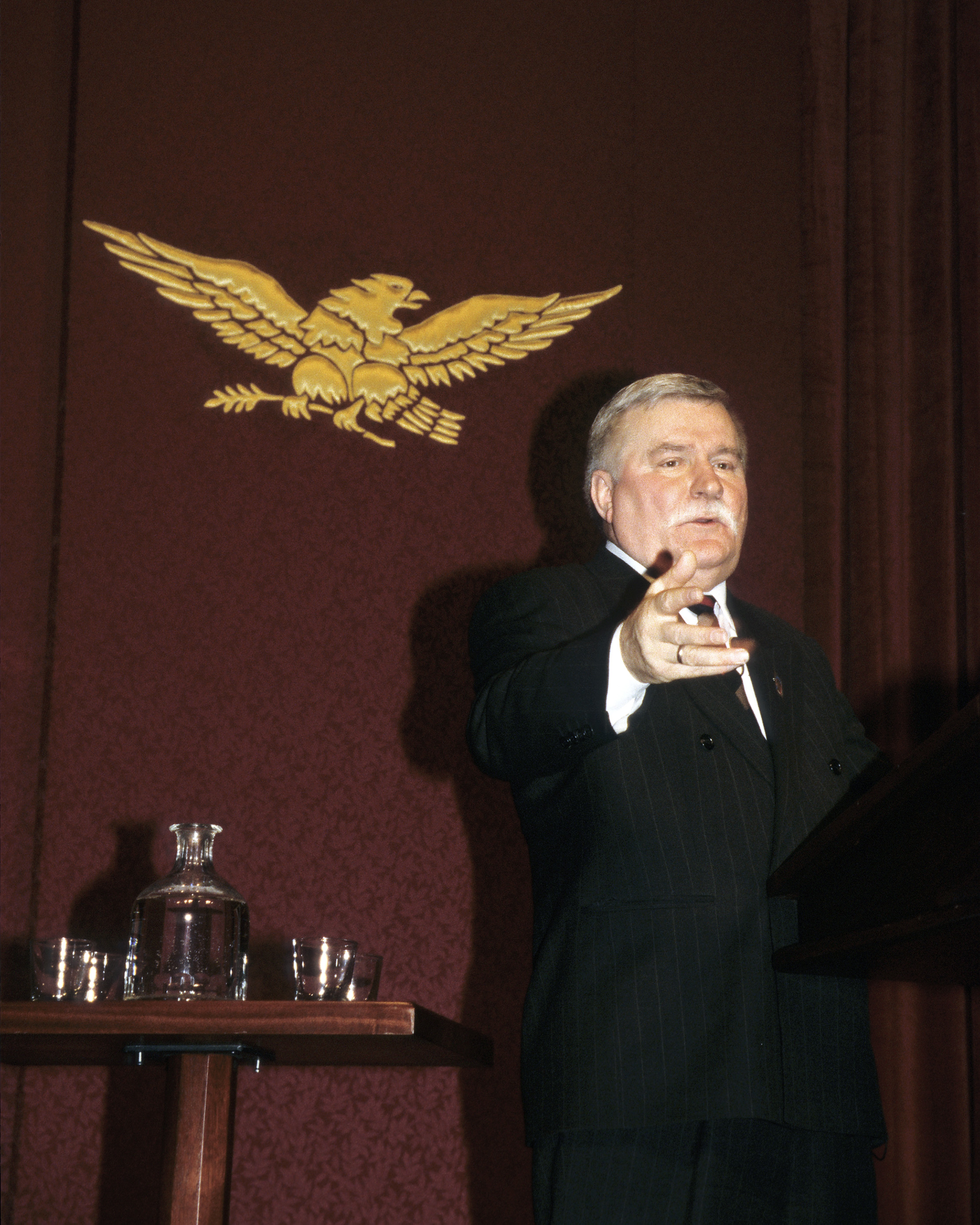
In later years, the former president alienated many of his admirers in Poland and abroad with his outspoken opposition to gay rights. He resigned from Solidarity in 2006 over its support for opening the files of the communist-era state security services. Since the 1980s, Walesa’s critics had voiced suspicions that he may have collaborated with the secret police in the 1970s. Walesa denied such charges, but his responses to the allegations were sometimes inconsistent. He was also accused of attempting to destroy incriminating records while he was President of Poland.
In 2016, files in the possession of a recently deceased communist general were made public, including purported records of Walesa’s work as a paid informant for the communists, prior to his involvement with Solidarity. Although Walesa disputed the documents’ authenticity, many former supporters found the evidence credible, and he remains embroiled in controversy over his past actions.
“I had conversations with all the powerful people of the world: with presidents, with prime ministers, chancellors and kings, too. None of them believed that there was any chance of us toppling communism before the year 2000. I didn’t meet a single person among those people who would believe that was possible. Not a single one in the whole world.”
In the 1970s, Lech Walesa was an electrician at the Lenin shipyard in Gdansk, Poland. He was fired for his outspoken criticism of the communist government, but when his old co-workers went on strike in 1980, Walesa scaled the shipyard fence to join them. The courage exemplified by this act of defiance inspired the workers to hold out until they had won recognition for Solidarity, the first independent trade union in the Eastern Bloc.
When Walesa received the Nobel Prize for Peace in 1983, the Nobel committee saluted “the power of victory which abides in one person’s belief, in his vision and in his courage to follow his call.”
As the Polish people’s demands for freedom grew louder, the government declared martial law and tried to outlaw Solidarity, but the genie was out of the bottle. After another Gdansk strike in 1988, free elections were held, and Solidarity emerged triumphant. In 1990 Lech Walesa, the former shipyard electrician, was elected President of Poland, an office he held for the next five years.
TIME magazine named him one of the 100 most influential people of the past century. Lech Walesa’s courage helped bring about the disintegration of the Eastern Bloc and the end of the Cold War.
(Lech Walesa’s video interview at the 2000 International Achievement Summit in London was conducted with the assistance of an interpreter.)
The Solidarity movement that you led brought about the end of the communist regime in Poland. But it began as a protest at the Lenin Shipyard. What was the cause of original conflict in the shipyard?
Lech Walesa: A shipyard is a kind of a window to the world. In a shipyard, people are arriving from all different places around the world. There would be sailors and there would be shipowners. So, that also incited discussions about working conditions, living conditions. So people would start comparing what money they make here and what money was made elsewhere. And, the point was that those people who were aware of other things, they would revolt more quickly than the others, by comparing the achievements of one system against the other and also the working conditions and the salaries. That’s why occasionally we would protest. Sometimes there were large-scale protests and sometimes they were smaller-scale protests. And, my career is actually made by those protests. Had we had better living and working conditions, I wouldn’t be here talking to you.

Weren’t people afraid to protest at first? It must have taken some persuasion.
Lech Walesa: When it comes to struggle, almost everybody is nervous and afraid, in every struggle all over the world. I think in Poland the anxiety was even stronger, because after all, we had to face the Political Police. We had the Soviet troops stationed in Poland for 50 years, over 200,000 soldiers based permanently on the territory of Poland. So, people would end up in prisons for some time, very often, they would be beaten up by the police. There were not so many people who would claim to be very courageous. Then again, you have people of different characters. Some are really put off by the hardships, by the difficulties, whereas the others actually strengthen. I was among the latter, who became stronger due to the hardships, and I got involved in my struggle with much more determination.
Why did the shipyard management tolerate you as long as they did?
Lech Walesa: I believe they’re asking themselves the same question now. I believe Gorbachev himself is asking the same question, because after all, I did lead to the dissolution of the Soviet Union, and he ceased being the First Secretary of the Communist Party. Despite that fact, he received a Nobel Peace Prize, and so did I. I got my prize for winning against Gorbachev and against the Soviet Union, whereas he received it for his defeat, which was considered valuable in a certain category. That’s the world, two opponents.

Before you changed the world, you were fired from your job in the shipyard. How did that happen?
Lech Walesa: I was fired on several occasions, because really, I got involved in the struggle with more and more determination, and I believe we can already quote the date 1970 as the date of my determined struggle. I was already the leader of the strike then. It was a very inefficient leadership on my part, and we failed with our strike in 1970, but that defeat caused my character — due to my character I spent the next ten years trying to work out the method that would actually bring about the victory. And when, ten years later, we had another opportunity, I already knew how to go about it, how to deal with it, and I led the struggle the way — as it should be.

What were some of the things you learned to do differently that led to the ultimate success?
I really had to think over every detail and everything, the whole defeat of 1970.
Lech Walesa: I had to go into really many details. How to achieve victory, what kind of an organization to establish in order to win this victory, and what would be the stages in which we could win the victory? How to avoid the tragedy of bloodshed, of being shut out, and how to negotiate, how to protect food, how to organize duties in order for the whole organization to function, and try to foresee all the possible situations that might happen. And, bearing in mind that there could be alternative outcomes, like a tragic one and a less tragic one, to take into account the behavior of people who are afraid. To take into consideration the behavior of the provocateurs, those who can provoke, and the opponents who would certainly carry out certain resistant action within us. So really, the ten years was not even enough for me to think over all those details. But in fact, when it came, when the situation actually happened, nothing came as a surprise to me. So that means I had foreseen almost all the possible details, not in full, not fully, but generally at least. And certainly, without that period of ten years, we wouldn’t have won the victory. Had it not been for the previous defeat, we wouldn’t have won the final victory. So, I would say that without the defeat of 1970 we wouldn’t have had the victory of 1980.

Why did it become a national movement and not just stay confined to Gdansk?
Lech Walesa: It’s hard to say it very briefly, but the point was that the communist system was bound to fail, because it was an inefficient economic system and it couldn’t keep up with the speed of progress in the West.
But there was one more thing that contributed to the victory. In the 1970s and in the 1980s, I had conversations with all the powerful people of the world: with presidents, with prime ministers, chancellors and kings, too. None of them believed that there was any chance of us toppling communism before the year 2000. I didn’t meet a single person among those people who would believe that was possible. Not a single one in the whole world.
When I continued saying that we were going to win against communism by peaceful means, they looked at me like a madman. And right now we are going to celebrate 2,000 years of Christianity, and we have this incredible thing happen to us. We get this divine gift from heaven, when nobody believes it’s possible. Here we have a Pole becoming the Pope. A year later, he visits Poland and he tells us, “Don’t be afraid. Change the face of this world.” And soon afterwards, we stopped fearing. The fear is gone. A year later, out of the ten people that I had in my command at that point, I have ten million supporting me, and I actually carry out the changing of the face of the world.

I consider this a gift of Providence to celebrate the 2000 years of Christianity. That was the 51 percent contribution to the success. The 35 percent that contributed to success is myself and Solidarity, and the remaining percentage is everybody else’s contribution. The actual stamp on the final victory was put down by President Yeltsin, who made a favorable atmosphere, who opposed Mikhail Gorbachev, and who withdrew Russia out of the Soviet Union. Without those three factors, we wouldn’t have final victory.
Although you may claim that the Berlin Wall fell down earlier, before Russia actually withdrew from the Soviet Union, I’m sure that even if it had fallen down without Russia doing what she did, it would have been rebuilt personally by the Chancellor of Germany and the President of the United States.
So, please consider these three factors as the major factors. Of course, from the perspective of different nations, there would be other additional factors, but they would be only minor.
