How long did it take to write?
Stephen Sondheim: I wrote most of it one night, and finished part of the second chorus and I’d gotten the ending. I don’t remember. At any rate, the whole thing was done in two days.
Which came first, the lyrics or the music?
Stephen Sondheim: They come together, sure.
So were you surprised when “Send in The Clowns” became the hit that it did?
Stephen Sondheim: Oh, completely. First of all, it wasn’t a hit for two years. I mean, the first person to sing it was Bobby Short, who happened to see the show in Boston, and it was exactly his kind of song, he’s a cabaret entertainer. And then my memory is that Judy Collins picked it up, but she recorded it in England. Sinatra heard it and recorded it. And between the two of them, they made it a hit.
What about Streisand?
Stephen Sondheim: Oh, that’s many, many, many decades later. I don’t listen to recordings of my songs. I don’t avoid it; I just don’t go out of my way to do it.
You were just thinking of what worked in the show, so you didn’t have the pressure of writing a hit.
Stephen Sondheim: When I wrote “Small World,” in Gypsy, Jule Styne, the composer, was very upset because he said, “This can only be sung by a woman, and my friend Frank needs a song.” Sinatra. That’s the way he thought, because he’d come from a generation in which you put the song in the musical, if it worked for the story, great, but the important thing was that it should get recorded.
When you finished “Send in the Clowns” did you have a sense that you had done something amazing?
Stephen Sondheim: No. I didn’t do anything amazing. I thought, “This is the kind of song that’ll be played in boites — supper clubs — and that’s all.” By that time, hit songs did not come out of musicals. Pop-rock was creating the hits. There were very, very few songs that made the charts, in any way, out of any Broadway musical. There was no hit from Fiddler on the Roof. Hello, Dolly! may have been the only one. And so one didn’t think in those terms. In the generation before me, the Rodgers and Hammerstein generation, that’s why they plugged the song, like in Oklahoma!, because popular hits came out of shows and movies. But this was no longer true, which was a great liberation because it meant you could write about anything.
To begin at the beginning, what is your first memory of being moved by music? Can you remember back that far?
Stephen Sondheim: No, not really. I started listening to classical music when I was in my early teens. Prior to that, I listened to pop records or band records, ’cause my father liked that kind of music. And I particularly liked watching… We had a Capeheart phonograph, which was a very elaborate mechanism in which 78s — which recorded three minutes on a side, and so you had to turn them over by hand — but this machine turned the record over by a very clever mechanical device, and I used to just watch it, and I think that’s how I got into music. I also took piano lessons when I was six years old. But I don’t remember being, quote, “moved” by a piece of music first.
Were your parents musical? Did they play instruments?
Stephen Sondheim: My father played piano by ear. My mother was non-musical, she was visual. My father would play. He loved Broadway shows and he would come home and approximate the songs on the piano, and he’d put his hands on the keys, and he’d put my hand, when I was tiny, on the melody, because he always played the melody with his little finger on the top. And so that was my exposure to piano.
Did he actually teach you piano?
Stephen Sondheim: Oh, no. He played by ear. He couldn’t read music or anything like that.
How soon was it apparent that you had a musical gift?
Stephen Sondheim: That’s hard. I have no idea. I took piano lessons when I was six and seven, but that’s what every nice, upper middle class Jewish boy did in New York City. It was really so my parents could show me off to their guests, playing “Flight of the Bumblebee,” and that sort of thing. And then I didn’t want to go on with it. I played the organ when I went to military school, when I was ten years old. They had a huge organ. In fact, I believe it was the second largest pipe organ in New York State. I loved all the buttons and the gadgets, because I’ve always been a gadget man. My feet could hardly hit the pedals, but I played, and that was fun for a year. And then I took piano lessons when I was in prep school, when I was 14, 15 and 16, and gave recitals around Pennsylvania. They wanted me to be a concert pianist, because I had a very good right hand, but my left hand’s terrible and I hated performing.
How did you respond to military school?
Stephen Sondheim: Loved it. My parents got divorced and military school gave me a structure. They sent me off. I think a lot of my class of kids, kids my age, were children of divorced parents, and they didn’t know what to do with the kids. I liked it a lot. That always surprises people. I liked knowing that I had to be here at 10:03, and do that at 11:07, and that sort of thing.
You were interested in math at one time, weren’t you?
Stephen Sondheim: Math was my big interest when I was in prep school. I took some math courses there and I was considering taking math in college, and majoring in it, but since I didn’t really want to be a mathematician I went to a liberal arts college, Williams, and so I just took liberal arts courses.
Did math help music?
Stephen Sondheim: Oh, sure it does. Math and music are intimately related. Not necessarily on a conscious level, but sure.
In what way? Symmetry? Balance?
Stephen Sondheim: It’s more than that. Harmonic relationships. It’s well-known, mathematicians and musicians are often one and the same.
And you like puzzles too, don’t you?
Stephen Sondheim: Yeah. That’s another aspect of compositional techniques that I enjoy. Fitting things together. I’ve always liked puzzles, since I was a kid, and I don’t know why.
What about games?
Stephen Sondheim: Games? That’s a different matter. Yes, I like party games and silly games. I loved chess. I like pure games like chess. But I’m not really into the luck games a lot.
What sort of puzzles interest you? Jigsaw puzzles?
Stephen Sondheim: No. Word puzzles, and logic puzzles and math puzzles. I enjoy jigsaw puzzles, but I’m not particularly visual. So I prefer the other kind.
We’ve read that you like something called “cut-throat anagrams.”
Stephen Sondheim: Anagrams is a game that, in its original form, has a set of protocols in which you form words out of a pool of letters, but you’re supposed to wait until the person whose turn it is gives up, and then you can say, “I see a word.” But in “cut-throat,” you don’t wait for anybody. You just turn the letter up and everybody yells whatever word they see. I was brought up, you know, by Oscar Hammerstein in my early teens, and he liked anagrams, but it was the decorous kind. And then, when I met Leonard Bernstein, he and his family played cut-throat anagrams, and that’s how I got into that.
As a composer, I wonder if there’s a sense, because you’re a lover of games and puzzles, that there’s always some solution to a given problem.
Stephen Sondheim: I’m sure that’s part of it. Art, in itself, is an attempt to bring order out of chaos, and certainly puzzles. The nice thing about doing a crossword puzzle is you know there is a solution. I also like murder mysteries for the same reason. Again, the puzzle murder mysteries, the Agatha Christie kinds of things where you know that it’s all going to be neatly wound up at the end and everything’s going to make logical sense. I think that’s why murder mysteries are popular, is this defense against chaos.
What books did you like to read as a kid?
Stephen Sondheim: The Oz books. I was never much of a reader. So much so, that when I got to college, I took every novel course I could get my hands on, to get into the habit of reading. To this day, I’m just not a reader. I’m a slow reader, which is unusual, because I’m so into language and I love words so much. But it’s hard for me to read.
What kind of student were you?
Stephen Sondheim: Oh, I was precocious. I skipped a couple of grades, so I was usually the youngest and I usually had the best grades. I found school a cinch. You know, there’s a knack to school. Also, I loved learning.
Did you ever think about writing books?
Stephen Sondheim: I’m not a prose writer the way I’m not a prose reader. That’s the problem…
Poetry?
Stephen Sondheim: No. Not particularly. I fell into lyric writing because of music, and because of Oscar. I backed into it.
Have you ever thought about what amazing good fortune it is that you happened to move next to the Hammersteins?
Stephen Sondheim: It’s not so amazing when you think of my mother, who wanted me off her hands. She was a working woman. She designed clothes, and she was a celebrity collector, and they had a son my age. So there are a series of circumstances that come together. It’s not so much luck. It was my mother’s ambition to be a celebrity.
Didn’t they call her “Foxy?”
Stephen Sondheim: Her maiden name was Janet Fox. She was a very talented dress designer, and my father was a dress manufacturer, and I have a feeling the marriage was one of convenience. I think she was in love with him, but I don’t think he felt about her the way she did about him.
Was that clear to you as a kid?
Stephen Sondheim: No, and it’s all speculation. She was a difficult woman, and I don’t think he was very happy being married to her.
You’ve told us about your extraordinary apprenticeship with Oscar Hammerstein. What do you think you learned from him?
Stephen Sondheim: Oh goodness, virtually everything. Structure. People underestimate what he did in the way of musical theater. He was primarily an experimental writer, and what he was doing was marrying the traditions of opera and American musical comedy, using songs to tell a story that was worth telling. The first real instance of that is Show Boat, which is a watershed show in the history of musical theater, and Oklahoma!, which is innovative in different ways. But it’s only one way of writing songs. He believed in dramatic song writing.
So what I learned from him was how to tell a story and so on, which is not what Cole Porter was doing, or Rodgers and Hart. There are other ways to write songs, and other uses of them. Now, because of the success of Oklahoma!, and subsequent shows, most musical theater now tells stories through songs. But that was not true prior to 1943, the year of Oklahoma! So he was teaching me that. But he also taught me how to structure a song. He taught me the use of a rhyme, and oh, everything. And about character. Inconsistencies. What is effective on the stage? Concision. All kinds of things. He was technically very, very good. His writing today, particularly, seems somewhat naive, but not if you look at it technically, and certainly not from the use of the imagination. His imagination, his creative imagination was far more sophisticated than the work itself, and has affected the theater permanently.
In another interview, you used the example of “Oh, What a Beautiful Morning,” that it sounds kind of silly if you just read the words.
Stephen Sondheim: Yeah. His kind of lyric writing was very understated. His lyrics don’t read very well. They sing, when they’re good, they sing great. Whereas, if you read Cole Porter’s, they’re very entertaining. “Oh, What A Beautiful Morning,” when you put it on paper looks vapid, but it’s not when it’s sung. That’s another thing he understood, which is how rich music is, and lyrics have to be underwritten. That’s why poets generally make poor lyric writers. Not always, but generally they do, because the language is too rich. It’s like what they call in England “over-egging the cake.” It’s over-enriching something, so that you get drowned in it. I firmly believe that lyrics have to breathe and give the audience’s ear a chance to understand what’s going on. Particularly in the theater, where you not only have the music, but you’ve got costume, story, acting, orchestra. There’s a lot to take in. The whole idea of poetry is denseness, is concision, is abutment of images, and that sort of thing. You can’t do that when you’ve got music going, and expect the audience to take it in.
Wasn’t there also something distinctive in Hammerstein’s approach to natural speech in a song?
Stephen Sondheim: Yes. I’ve never been a fan of Lorenz Hart’s lyrics, Rodgers and Hart, because I find them lazy and forced. You know, there are people who care about the musical theater, who will argue, some of them, that Rodgers and Hart were much better than Rodgers and Hammerstein. That Rodgers and Hammerstein were simplistic, and Hart and Rodgers were so sophisticated. Oscar, on the other hand, used to defend Lorenz Hart to me. He said Hart was one of the very first to try to make natural speech a part of lyric writing. The sound of conversation. And he’s right. He’s not exactly a pioneer but he was certainly one of the first.
Could you tell us about the first show you wrote for Broadway, Saturday Night?
Stephen Sondheim: By the time I’d done the four musicals that Oscar had sort of urged me to do, I was really, at the age of 22, a professional. A young and flawed professional, but not an amateur. And there was a play called Front Porch in Flatbush that had never been produced, was going to be produced by a man named Lemuel Ayers, who had had a huge success recently producing and designing Kiss Me, Kate. And a couple of other things, but that was his big hit. So he wanted to produce this as a musical. It takes place in Brooklyn in 1928, this play, and it was written by two brothers who were primarily screenwriters, Philip and Julius Epstein. They’d written about their childhood and about their own brother, a third brother, who was something of a scapegrace. Lem had approached, I think, Frank Loesser, and somebody else, and they’d turned him down. And I happened to meet Lem, we were ushers at a wedding together, and he asked to hear some songs, and so I played him some songs I’d written, and he commissioned me to try three songs for this thing, which was to be retitled. Julie Epstein came in from California and I got the job. I came out to California and worked with Julie out here for five months, staying at Lem’s house. Lem was designing a movie. Then we went back East and we did eight backers’ auditions and we raised about half the money. And then Lem died. Unbeknownst to me, and to most people around him, he had leukemia. He died at an early age, early 40’s, and the rights passed to his widow, Shirley, and she wanted to go on with it but she had no experience and she couldn’t do it. So the show never came to fruition. But it was a professional score, and now I had a real portfolio to play. So that’s the importance about that show, to me.
What were the circumstances of your meeting Arthur Laurents?
Stephen Sondheim: My first paying job was here in California, as an assistant writer to a man named George Oppenheimer on a TV series called Topper. We alternated writing scripts. George had a friend named Martin Gabel, who was an actor and a producer in New York. Martin Gabel and a guy named Henry Margolis were going to produce a musical of the James Cain novel, Serenade. It was originally to have been written by Bernstein and directed by Jerry Robbins with a book by Arthur Laurents. Bernstein and Robbins had dropped out. They were looking for a composer, so George brought me up to Marty’s house and I played some of the songs from Saturday Night. Arthur Laurents was to be the book writer, so he heard the songs. Then, shortly afterwards, Warner Brothers announced their plans to do Serenade. They had the rights. Warner Brothers came out with the movie, so the project was dropped. But Arthur had heard my stuff. Then, many months later…
I was at an opening night party that Burt Shevelove had invited me to. That’s the man who wrote Forum, and was a good friend. He had been to the opening. I didn’t go, but he said if you’d like to go to the opening night party afterwards, show up at such and such an apartment. And so I did, and I got there before Burt, so I didn’t know anybody, except suddenly there was this familiar face, it was Arthur Laurents, and we chatted just to make small talk. I asked him what he was doing. He said he was about to start on a musical version of Romeo and Juliet. I said, “Who’s writing the score?” He said, “Leonard Bernstein and, I think, Betty and Adolph,” meaning Comden and Green, “Except they’re not sure they can get out of a Hollywood contract. We’ll know in a week.” And he said, “You know, I never thought of you. If they don’t do it, would you like to audition for Bernstein? ‘Cause I loved your lyrics,” he said. “I didn’t like your music very much,” he said — Saturday Night — “But I loved your lyrics,” he said. And I said sure, and I didn’t really want to write just lyrics, but I wanted to meet Leonard Bernstein. And so I met him the next day and I played for him, and he said, “I’ll call you in a week and let you know about Comden and Green.” First of all, I assumed that Comden and Green would be able, easily, to get out of their contract, and secondly, I didn’t want to write just lyrics, because music was always the first reason I was writing songs. And sure enough, the phone rang, and I said, “Oh, well, let me get back to you,” and I went to Oscar and said, “You know, I really want to write music but…” He said, “Take the job.” He said, “First of all, these are really experienced and talented men, Bernstein and Robbins and Laurents, and you’ll learn a lot, and so you write music later.” And that’s exactly what I did, and his advice was very good.
The credits for West Side Story say “Conceived by Jerome Robbins.” What was Robbins’s role in the genesis of that show?
Stephen Sondheim: It depends on what account you read. The point is that he wanted to do Romeo and Juliet. I think he was coaching Montgomery Clift in a scene or something, and he got the idea of doing Romeo and Juliet, and to do it between Catholics and Jews on the Lower East Side, and he enlisted Arthur and Lenny. Arthur felt — this is Arthur’s account anyway — that it would just be Abie’s Irish Rose set to music. And so then they were all out here in California, sitting around the Beverly Hills pool, and they picked up a newspaper and there was a headline about gang warfare in New York and Puerto Rican street gangs. And the figurative light went on, or something like that. I don’t know what the gap of years was between that and when they started to write it.
In the biography of you by Meryle Secrest that recently came out, it says that you originally agreed to be a co-lyricist on West Side Story.
Stephen Sondheim: Yes. Lenny wanted to write lyrics too, and he was afraid of taking a chance on an unknown. So we worked together, but by the time we opened in Washington all the lyrics were mine, with some one- or two-line exceptions. And so he very generously took his name off the lyric writer list.
Is it true that he offered you a little more of a percentage?
Stephen Sondheim: Oh yeah. There was four percent of the gross for lyrics and music. In those days, it was six percent for book, music and lyrics: two, two and two. In point of fact, because Bernstein and Laurents and Robbins had such clout, it was a slightly larger percentage. For the music and lyrics, it was four percent. Lenny was to get three, I was to get one, and Lenny said, “We’ll even out, because you deserve…” buh-buh-ba, and I foolishly said, “Oh, don’t be silly. All I care about is the credit.” Somebody should have stuffed a handkerchief in my mouth, because it would have been nice to get that extra percent.
What was Leonard Bernstein like to work with?
Stephen Sondheim: Fun. A lot of fun. We had numerous shared tastes, particularly British crossword puzzles — which in fact I introduced him to — and anagrams. We played cut-throat anagrams, which is the way we’d get off any kind of hidden hostility. There was never any overt hostility at all. And he liked working with somebody who knew music, who was a musician. He had never written with somebody who was a musician before. And so the main difference was he liked to work together in a room and I liked to work separately. So we compromised. We’d separate for two days and then we’d get together on the third day. We talked on the phone a lot. It could not have been a better and more stimulating and good collaboration. A great time.
He was already conducting at this time?
Stephen Sondheim: He was conducting, but he was to take over the Philharmonic in the fall of ’57, and we had intended to go into rehearsal in July, so there would be no problem, no conflict. But, the producer, Cheryl Crawford, dropped out at the last minute. She’d been the putative producer for over a year. But she suddenly got cold feet. And so there we were, knowing that we had to get the show on by September because Lenny was unavailable starting in September. I had urged them to give the show earlier to Hal Prince and his partner, Bobby Griffith, but though they had done two successful shows, Pajama Game and Damn Yankees, Lenny and Jerry and Arthur didn’t feel that they were experienced enough. So they preferred Cheryl. When Cheryl dropped out, I called Hal myself, who was out of town with a show called New Girl in Town, which was not going well, and so he was more than anxious to start a new project. However, I had played him the score before and he did not like the show, West Side. But because of that moment, catching him — vulnerable — in the last couple of weeks in Boston, and knowing that the minute the show opened in New York he would have something else to work on, it softened him up. And so he and Bobby also brought in another producer, Roger Stevens.
Generations have grown up knowing and loving your lyrics for that show, but you’ve said that you don’t care for them. Would you want to rewrite them?
Stephen Sondheim: No. I don’t want to rewrite them. They’re just not very good. That’s a difference. They’re very self-conscious lyrics. You can smell the writer, instead of the characters. They’re obviously coming from the writer. Now the whole play — the book, which I think is brilliant because of how much it accomplishes in such a brief time — is also arch. Very stylized language. So I was justified. But as I said before about lyrics, music blows lyrics up very quickly, and suddenly they become more than art. They become pompous and they become self-conscious. I like “Something’s Coming,” and I like “The Jet Song,” and a couple of other moments, but that’s about it.
There’s a moment you’ve described in the genesis of West Side Story when Robbins wanted you to tell him what Tony was supposed to be doing. What was that about?
Stephen Sondheim: Lenny was away. We’d finished the song, “Maria,” and I went up to play it for Jerry, and Jerry said, after he heard it, he said, “Yeah, that’s all fine, but what’s he doing?” I said, “What do you mean what’s he doing?” He said, “What’s the character doing?” I said, “He’s singing a song. You know, he’s standing there like you do in musicals, and you sing a song.” He said, “Well, how would you like to stage it?” he said, ’cause he was always quite hostile. And I said “What do you mean?” He said, “Tell me, stage it.” And I realized what he was saying is that there should be some kind of stage action built into a song. That you should, as a songwriter, choreograph it yourself, in some way, even if it’s just a so-called static love song. And it was a very important lesson. I’ve always done that, which is why directors like working with me. Because I always give them a blueprint, which they can either ignore, or which they can use as a springboard. But there’s always a blueprint. I never say, “Well, here’s the number.” I will say, “Here, he’s sitting on a chair, he gets up, he pours himself a cup a coffee, he sings the first…” whatever it is. And often, particularly when I worked with Hal Prince, I would get the dimensions of the set, so I would know how long it took a character to get from X to Y, and write accordingly. So the director isn’t suddenly stuck with saying, “I need eight more bars.”
We’d love to hear about some of the music that has inspired you. You’ve mentioned Ravel.
Stephen Sondheim: I did my junior thesis in college on the Ravel left-hand piano concerto. I’ve always been a fan of his. And I did my senior thesis on the Copland “Music for The Theater.” I’ve always been a fan of his. My music probably has less evidence of Copland than it does of Ravel. There are certain composers whose music I love, like Stravinsky, Britten, Ravel and Rachmaninoff, and they show up all the time in my stuff.
Did Bernstein’s music have any influence?
Stephen Sondheim: No. Although I have to qualify that. Though he was, by jazz standards, a very square composer, he was, by musical theater standards, a not square composer, and he taught me to be less square. I tend to be square.
Was it that military school training?
Stephen Sondheim: No, I think it’s lack of imagination.
You wrote lyrics for Do I Hear a Waltz? to the music of Richard Rodgers. You had already written a lot of your own music by then, but he was Hammerstein’s old partner. Was it an interesting experience working with him?
Stephen Sondheim: No, it wasn’t very interesting. He (Richard Rodgers) was sort of at the end of his creative career. It was very difficult working with him because he was afraid to rewrite. He was afraid that he’d reached the bottom of the well. I’m one of those believers that writing is a matter of rewriting, and he would resist any change in a song, because he was afraid that if he tried to rewrite something he’d come up empty. He also was a very paranoid man, so that was another problem. Because Arthur and I were great friends, we collaborated a lot — Arthur Laurents — and it was based on a play of Arthur’s. Rodgers was the producer, so he had the whip hand. So it became this kind of feud. It only surfaced, as such, a few times, but it was always there. When I first started to work with him, he had a great time working with me because, again, I was a musician and he had never worked with a musician, and so we had a common language. And the kind of lyrics I was writing had an echo of Hart in them, because they were kind of hip, but the story’s a sentimental one. So over a period of time… And particularly, we got out of town and the show didn’t work very well, and then he went berserk.
What do you mean, he went berserk?
Stephen Sondheim: At one point he tore up a lyric of mine that I had worked 36 hours on, in front of the whole cast, and called it a piece of shit.
How did you handle those kinds of professional disappointments, and rise above it and keep going?
Stephen Sondheim: Everybody does that. It’s your living. I’d written a show, Anyone Can Whistle, which only lasted nine performances, but I liked the show. Forum had been a big hit. That was my first show with music on Broadway. And then came Do I Hear a Waltz? after Whistle. I thought I’d be devastated the first time I had a big flop, but I wasn’t. You’re disappointed and it sounds mealy-mouthed to say but it’s true. My main disappointment is that people I want to see it aren’t going to get a chance to see it. That’s my main disappointment.
You’ve said writing is a matter of rewriting. It’s interesting to read about the evolution of some of these shows, where songs are dropped, songs are added, and some of these songs that are dropped are great songs.
Stephen Sondheim: But that’s part of the process, isn’t it? Something might not fit in the show. Musicals are — particularly musicals — plays also, but musicals particularly are… the last collaborator is your audience, and so you’ve got to wait ’til the last collaborator comes in before you can complete the collaboration. And when the audience comes in, it changes the temperature of what you’ve written. Things that seem to work well — work in a sense of carry the story forward and be integral to the piece — suddenly become a little less relevant or a little less functional or a little overlong or a little overweight or a little whatever. And so you start reshaping from an audience.
Is that a really important part of the process, being able to let go of some of your children?
Stephen Sondheim: That’s something I learned from Oscar. He and Rodgers had written a ballad for Oklahoma! called “Boys and Girls Like You and Me,” and they played it in the overture, and they sang it in the first act, and they did it in the entr’acte, and reprised in the second act. It was their big “plug” number to be a popular hit. And they dropped it in New Haven because it didn’t serve the function in the show that it could, and that’s ruthlessness, and I learned that from Oscar.
But sometimes you also have to write new songs for a show when it’s already in previews out of town, don’t you?
Stephen Sondheim: What happens is, when you’re out of town or… yeah, out of town is what it amounts to — although that one was written during rehearsals — you know your cast well and you know their strengths and weaknesses, and you can start writing for them. Just the way Shakespeare wrote for his actors. And I’ve said it with heavy humor, that I really don’t want to write a score until the whole show is cast and staged, because… that’s why so many good songs get written out of town, and written fast, because you know exactly what’s missing, you know exactly what has to work or happen, you know exactly who you’re writing for, you know exactly what the audience is starting to feel. And so the more restrictions you have, the easier anything is to write, and when you’re out of town and you’re restricted by all those factors, it’s much easier to write them than when you just have a tabula rasa and say, “Gee, we’ve got to have a love song here.” You know, it’s not the same thing.
You’ve said that, in a way, writing a song is like acting because you are exploring your character.
Stephen Sondheim: Writing a song in a musical that tells a story, sure. The way you get into the character — the way you get in the song, both musically and lyrically — is to become the character. It’s the only way. I don’t know how else you do it, unless you’re the playwright who created the character in the first place. But I’m always writing for characters that somebody else has created, my collaborator, and so the only way I can get into… I’ve said — and it’s probably an exaggeration, but not much — that by the time I get through writing a score, I know the book better than the book writer does, because I’ve examined every word, and questioned the book writer on every word. Why does she say this? Why doesn’t she say that? And that’s getting to know the character. And then writing the song is acting it. So I can start ad libbing. It’s exactly like improvisatory acting. So here’s the character Blanche. We’re hiring you to play Blanche. Okay. Just veer from the Tennessee Williams script and just start ad libbing as Blanche. If you’re thoroughly in the character, you can do it. You may not have the poetry yet, but everything you say will be in the character of Blanche. That’s what I do. I take off from what the book writer has written, sometimes using a line of his as a springboard, and ad lib, and improvise as that character. That’s what I’m doing.
Does the playwright sometimes provide you with more than what’s written in the script, like descriptive things about the character?
Stephen Sondheim: Sometimes. Not so much descriptive things, because that comes out of conversation. I talk for weeks to the book writer to discuss just such matters. Sometimes I’ll ask the book writer to write a monologue, not to be performed, just as if they were notes for the character, because nobody knows the characters better than the guy who creates them.
Arthur Laurents wrote that you’re a master of writing a lyric which can only be sung by the character for whom it was intended.
Stephen Sondheim: That’s the idea. It’s that character’s song. You don’t write a line for Stanley that’s supposed to be said by Blanche.
Could you tell us about your show Company? It seemed so innovative when it came out, a real departure from what came before. What was that leap about?
Stephen Sondheim: The leap came about through the form. What’s innovative about Company is it blends two traditional forms for the first time: the revue and the book show. It’s a revue, but it tells a story. Doesn’t have a plot, but it has a story. Revues up to that time were just collections of songs by the songwriters. That whole generation — Rodgers and Hart, Irving Berlin, Cole Porter — they all wrote revues, just collections of their songs. Sometimes with a theme, as in As Thousands Cheer, which was a revue, but each number was preceded by a headline from the newspapers. But nobody had ever tried to blend the two. And we didn’t try. It’s just that George Furth had written these one-act plays. George was supposed to go in rehearsal. There was a production set, it fell apart. He said, “What shall I do with the plays?” I said, “Hal (Prince) will know what to do with the plays. He’s really good at this sort of thing.” And so George sent the plays to Hal, and to our surprise, Hal said, “I think they’d make a musical.” And so we sat and tried to figure out how to tie these disparate plays together. But George had unconsciously written all these plays — not really unconsciously because the production was to use the same three actors for all the plays. Each play that he had written, and they’re short plays, was a couple and an outside figure, varying ages, varying sexes. It wasn’t always the guy who was the outsider. And we suddenly, in examining them, realized that you could use that outsider as a central character and have all these plays. And about two-and-a-half of those plays are still in the show, and the others were written specifically for Company. And that’s what it is, it’s a collection of playlets. But they’re held together by a character who changes, or who observes, and who is not just like an MC but somebody who is integrated into all these plays and then turns out to be the leading character.
Your collaboration with Hal Prince, the producer and director, lasted for such a long time and was so successful. What was he like to work with?
Stephen Sondheim: Stimulating and funny, and we were friends for a long time too, and still are. The primary thing about Hal (Prince), for me, is his enthusiasm, and impatience. I’m a low flame and he’s a high flame, and that’s one of the things that makes us a good team. Coming away from any meeting with Hal, or a discussion on the phone, or anything like that, I always want to write. And in the case of Company… Some of the shows I did with Hal, he was very much responsible for the building and the growth of the show. Some, like Sweeney Todd or Night Music, were just shows that were sort of brought to him. But Company… Follies was brought to him. Jim Goldman and I brought it to him. But then he had a take on how to stage it, which then affected the writing. So the thing is, it’s primarily about stimulation, and of course his theatrical imagination. I mean, apart from the skill too. But in terms of the personal.
Was it Hal Prince who came up with the idea of the ghosts who hover over the action in Follies?
Stephen Sondheim: No, we always had that, Goldman and I. But the idea of the pervasion of the ghosts, that came about later. James and I had limited theatrical imagination. We were afraid of flashbacks because of the scenery suddenly coming on and all. Hal said there’s no need. He said, “I would like to stage it with just light, like a ballet, so you can have simultaneous scenes going on.” That meant that we could have figures from the past that we had dealt with in another way, on the stage simultaneously.
Then Michael Bennett suggested that the ghosts of people who were not characters in the show should go through the show, atmospherically, with the combination of the lighting that Hal was talking about that allowed us to play scenes simultaneously. So while you and I are talking, our younger selves are talking over there, and you don’t need a different set. And while we’re doing that, behind you there are shadowy figures who are pieces of scenery. The showgirls’ ghosts were pieces of scenery. The characters’ ghosts were their younger selves. So there are two levels of old figures in it.
That musical changed quite a bit over the years, didn’t it?
Stephen Sondheim: Oh yeah. Before we brought it to Hal, it started out as sort of a “who’ll do it,” not a “whodunit,” in which we brought four characters together to a party who’d had a complicated relationship in the past, and their old angers and insecurities and passions are reignited at this reunion, and at the end of the first act, they each had reason to wish one of the others was dead. So the so-called suspense was: who’s going to attempt to kill whom? And then we gradually realized that every time, in each rewrite, we would read each version and it was too plotted, and so we would take out a little of the plot and just have the party, and then it still was too plotted. We finally woke up to the fact that we should have no plot at all. It should just be these emotional relationships at a party. They all get drunk, they resolve or don’t resolve their problems, and they go home.
That was pretty daring for its time.
Stephen Sondheim: Yes, it was. It’s interesting. That’s what it shares with Company. Neither of those shows have a plot. They’re entirely different as structures, and in every way, except neither of them has a plot. They both have stories but no plots.
That was somewhat difficult for some people to take.
Stephen Sondheim: To put it mildly, yeah. Hal agreed to do Follies, but he only agreed to do it if we did Company first. Follies had started years before Company came up. And so in a way, the plotlessness of Follies helped us have the courage to have a plotless Company.
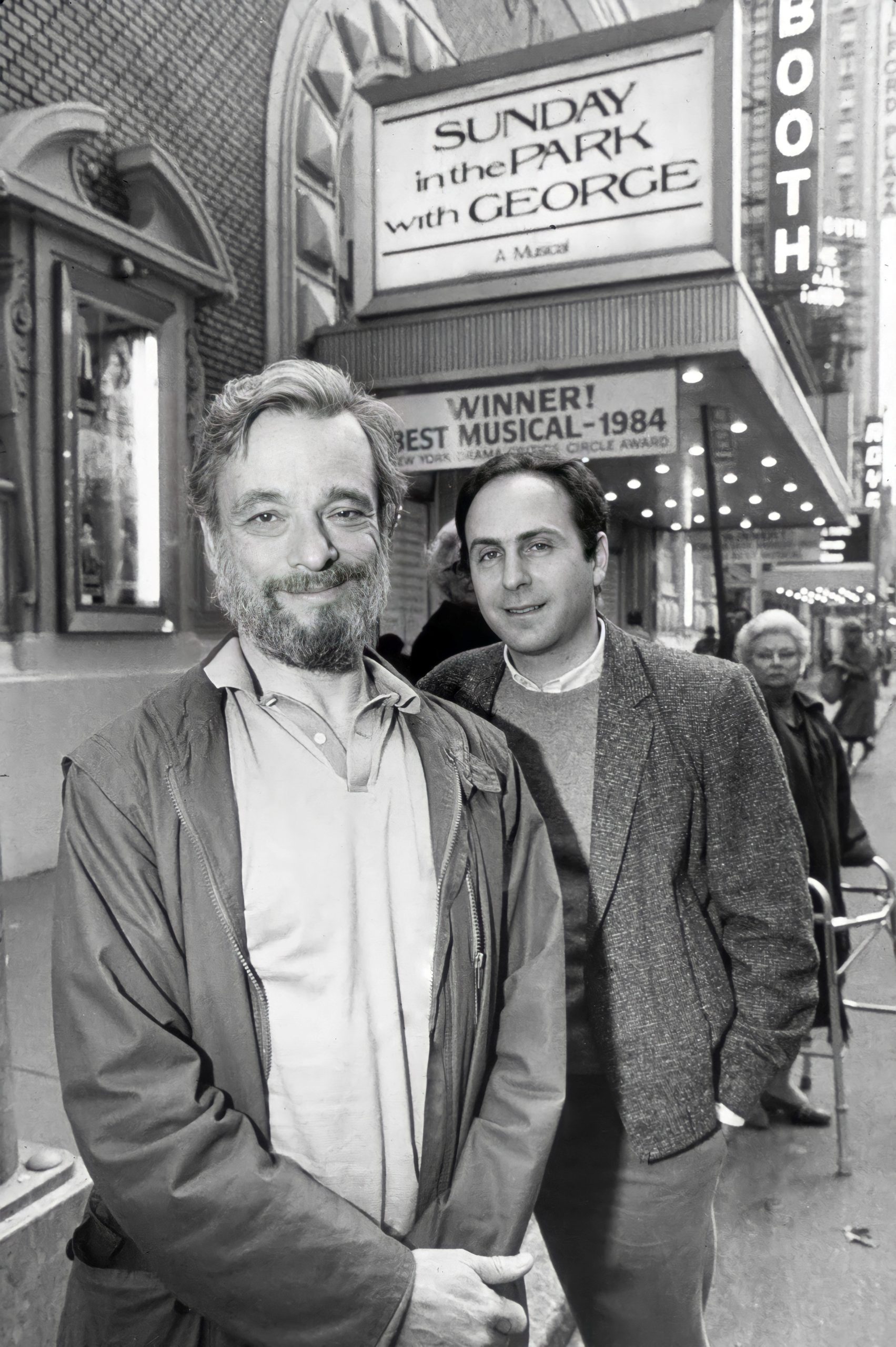
Your show Sunday in the Park with George won a very well-deserved Pulitzer Prize. That conception started with a painting. Can you tell us how that came about?
Stephen Sondheim: It started with James Lapine. I’d seen a play that he wrote and directed called Twelve Dreams, and was knocked out by it and wanted to collaborate with him. By coincidence, he wanted to collaborate with me, and we were brought together by a producer named Lew Allen. James was of a generation below me, and not just in age, but in approach to theater. He came from Off-Broadway, where his plays had been done, a much looser approach. I won’t say improvisatory, because his plays are very carefully written, but in not-for-profit theater, you don’t worry so much about how the audience is going to react. You want to make them absorb the piece.
So we had to get to know each other, and we discussed movies we liked. We realized that we operate on the same levels in many ways. He had been a photographer and a graphics designer, and he would bring up photographs, some which he’d taken, some which he’d taken out of magazines, and just spread them out on the floor, just to see how they abutted, which is exactly the reverse of how I’d been trained, to start with a story and begin at the beginning. What he was doing was taking off from his imagination and seeing what would suddenly strike us.
One evening we got to discussing this Seurat painting James had used it in a play he had directed, by Gertrude Stein, called Photograph. It’s actually just a one-page scenario for a possible play. We started talking about the painting. And I said, “The whole thing’s always looked like a stage set to me.” And it also had started because he asked me what kind of show I might want to write, and I said, “I want to write a theme and variations.” That was the kind of show I always wanted to write. And I brought him a magazine called Bizarre, with variations on the Mona Lisa. So we started talking about variations, and we started talking about this set, and James said, “Do you realize, nobody in that picture…” — and there are 48 people or 50 people — “…is looking at anybody else? Why is that, do you suppose? Perhaps they’re hiding from each other. Perhaps they’ve having illicit affairs.” Perhaps, perhaps, perhaps. And then he said, “The main character’s missing.” I said, “Who?” and he said, “The artist.” And once he said that, the light bulb went off and we knew we had a play in mind, because it’s about a man who controls the landscape, et cetera, et cetera, et cetera. That’s how it started, and we just wrote.
It’s hard not to hear some of those lyrics as music about the act of creation.
Stephen Sondheim: Once you say the artist is the main character, then you know at least one of your themes is going to be about creativity. The other interesting thing, was that pointillism does exactly what we were trying, or we were trying to do what pointillism does, which is take this image and that image — meaning emotional images, character, et cetera — and make them so they all finally come together and make a whole that tells a story.
Were you surprised to win the Pulitzer Prize? Because the Tony Awards that year were a bit of a disappointment.
Stephen Sondheim: Yeah. Very few people liked the show. We were sneered at a great deal by the newspapers and by the public. Frank Rich, the critic for The New York Times, liked it a lot. He did not give it a rave on the opening night, but he was stimulated by it, and he kept coming back to see it, and kept writing about it. So it became a sort of pet in The New York Times, which also raised a lot of hackles. Audiences were baffled by it, many were. We had a number of walk-outs. You know, the Tonys ignored West Side Story. The Tonys ignored Gypsy. They’re worthless and they’re useless, except when they sell tickets, which they don’t do any more. So we were disappointed by the Tonys, because it’s a kind of public humiliation. But no, I had no idea. You have to be submitted for the Pulitzer, and unbeknownst to us, a choral director whom I know had submitted us.
How did you hear that you won?
Stephen Sondheim: James was doing a… we were planning a revival of a revised version of Merrily We Roll Along, which he was to direct, ’cause Merrily We Roll Along had been this gigantic failure and James had liked it — liked the score anyway, and also the book — and he had some ideas as to what George Furth, the book writer, and I should do to clarify and improve things, in the first half-hour particularly. So he arranged to have it done out at La Jolla, and we were planning it one afternoon. We were having a production meeting, and the phone rang, and my informant, whoever it was, said, “Guess what? You’ve just won the Pulitzer Prize.” And I wrote it on a piece of paper, because James was talking to a set designer and all that. I just slipped it in front of him. I wish I could say there was some great dramatic reaction. There wasn’t. He just opened it and he said something, “Oh, that’s nice,” or something, went right on.
Could you tell us a little bit about the circumstances under which you compose? Do you create a particular environment that works for you?
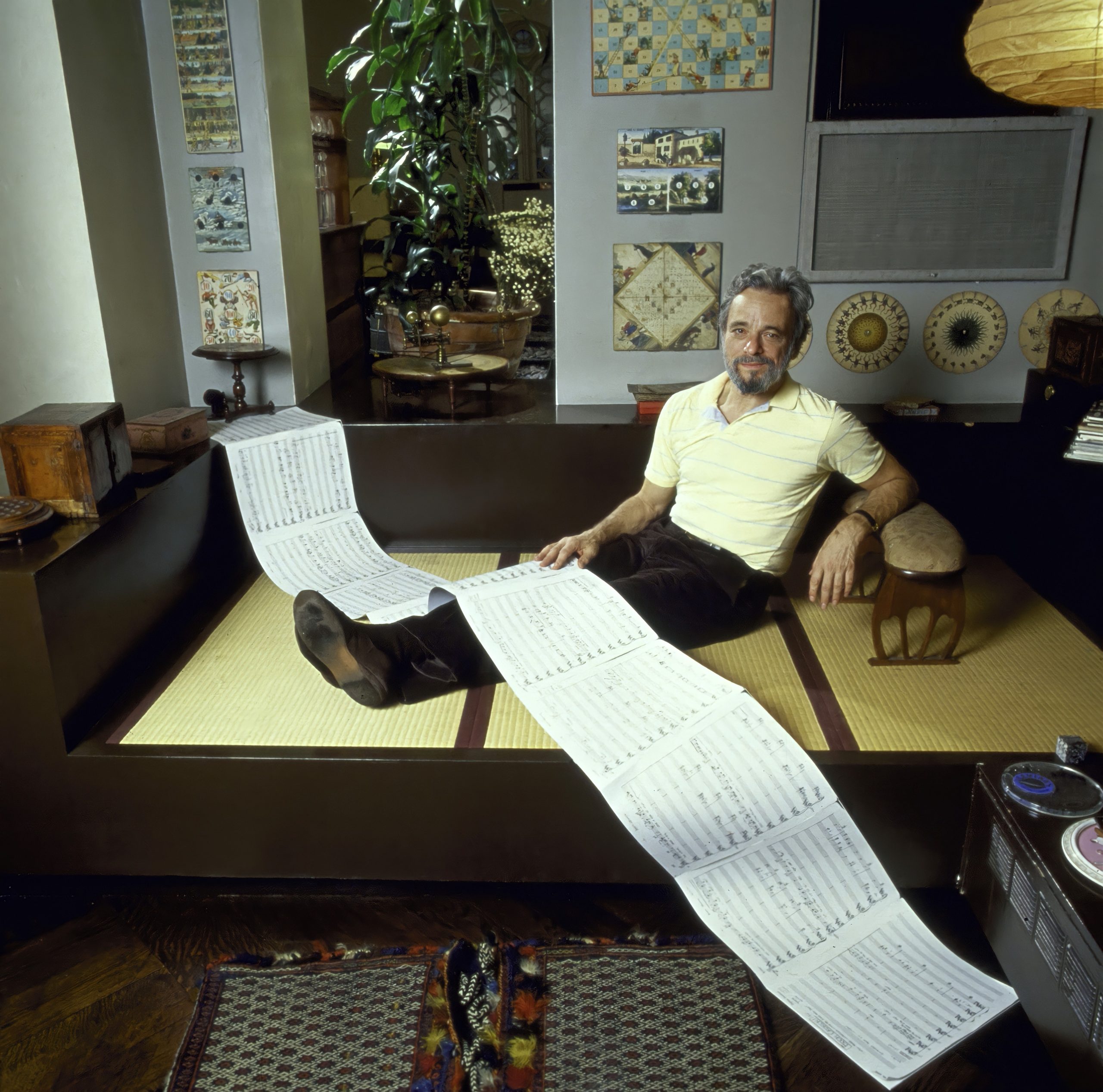
Stephen Sondheim: No. I have a studio. I now have a house in Connecticut as well as a place in New York. So I have a studio in each place, and that’s where I live my life.
Is it easier to work where it’s quiet?
Stephen Sondheim: That’s interesting. It’s pleasanter to work in the country, where it’s quiet and where you can wander out among the trees. But I don’t get as much work done. In the city there’s more pressure. You don’t want to leave the room because there’s all that chaos going on. So it’s more like a monk’s cell, in the sense that you’re isolating yourself from the world. I think that leads to more work. It’s like doing homework, if you’re forced not to leave a room. Of course I’m not forced, but I think of it as a force, as something keeping me in the room. You eventually get bored enough so you put the pencil to paper.
They locked Rossini in a room to get his overtures.
Stephen Sondheim: I didn’t know that. Well, Rodgers was famous for locking Larry Hart in rooms to get the lyrics.
Do you use any special kind of paper or pencil?
Stephen Sondheim: I use Blackwing pencils. Blackwings. They don’t make ’em any more, and luckily, I bought a lot of boxes of ’em. They’re very soft lead. They’re not round, so they don’t fall off the table, and they have removable erasers, which unfortunately dry out.
And paper?
Stephen Sondheim: Yes. Yellow lined pads. I used to have them so it was, I think 26 lines to a page, and my friend, Burt Shevelove, who was a stationery freak, said, “Buy cartons of them!” I said, “Oh Burt, come on. I’ll buy 12 pads. That will be enough.” God, was he ever right, because they discontinued making them about 20 years ago. I’m used to the other pads now. You get used to the exact amount of space between lines, because you write a word and then you write an alternate word over it. You want enough room so you can read it, so the lines can’t be too close. But if they’re too far apart, you don’t get enough lines on the paper. I could go on. I’m sure many writers have these tiny little habits. All over the United States there are people who only use Blackwings. I sometimes get letters, “Do you have any source for the Blackwings?”
And they’re extinct?
Stephen Sondheim: Yeah, they’re extinct. Adam Green, Adolph Green’s son, has written an article for The New Yorker, which I think will be published next year. Quite a long article on the Blackwing pencil and the fanatics who go crazy when they don’t have a Blackwing in their hand. You just get habituated. Of course you can still write. If there were no yellow pads in the world, I’d find a way of writing on white paper or on non-lined pads. It’s the lined pads that make it. Yellow is just good because the contrast of the yellow and the black lead is just easier on the eyes than white.
In Meryle Secrest’s biography of you, you’re quoted as saying that you found writing music easier than writing lyrics. Is that true?
Stephen Sondheim: I just said that lyric writing is harder than writing music. In the sense that your resources are so much more limited. One of the hardest things about writing lyrics is to make the lyrics sit on the music in such a way that you’re not aware there was a writer there, and it sounds natural. Well, that means things like inflection, the elongation of syllables. Now I’m talking about a certain kind of songwriting. You know, opera librettists and opera composers will take a word and do a whole melisma on it, because it’s not about the language. It’s about the voice and the music. But if you’re dealing with a musical in which you’re trying to tell a story that is like a play, and particularly if you’re trying to tell a contemporary one, or something from the last 50 years, it’s got to sound like speech. And in order not to sound so songlike that you lose the scene. At the same time, it’s got to be a song in the sense that — I loathe recitative — and so it should have a form, and I think the form is what gives it power, and the more formal, in a sense, the song is. You have to juggle all those things, and that’s hard work. That’s really hard, and usually it doesn’t come out quite the way you want it. Maybe all writers would say it never comes out the way you want it. It’s particularly noticeable in a lyric because the form is so short. You know, you’ve got 50 words. One of them out of place is like having a novel with one out of 50 chapters out of place. But you’ve got 49 long chapters so that — but in a short period of time it stands out, the wrong word, and because each word becomes so important.
John Updike was quoted in a New York Times article as saying that every time he walks into a bookstore he sort of snickers because he can’t believe somebody would buy one of his books. He feels like such a fraud. Do you recognize that feeling?
Stephen Sondheim: Every writer that I’ve ever spoken to feels fraudulent in some way or other. You don’t feel it all the time, but particularly if you’re successful, or rather if people admire you a lot and it’s not even success. That increases the sense of fraudulence. “Hey, I’m not that good! Stop comparing me to so and so.” And then you do feel fraudulent.
I guess if you weren’t self-critical, the stuff wouldn’t be as good.
Stephen Sondheim: No, probably not. Sometimes you can be so self-critical you take the blood out of a piece, and that is often a danger. Or you can be Thomas Wolfe and just collect all the stuff in a box and have Maxwell Perkins edit it for you. So there are extremes. Those books are good and rich and full of life, and he had an editor who really took what he had and helped form it. They’re full of blood and life. Maybe if he’d been self-critical it wouldn’t be as good.
At Oxford University, you told the students they should not be critical, at least at the beginning.
Stephen Sondheim: The worst thing you can do is censor yourself as the pencil hits the paper. It’s particularly true in lyric writing because things become… You know, it’s easy for a novelist to say, “I love you.” You know, it’s three words out of 300,000. But if that’s in your lyric and you think, “Oh Jesus, I can’t. No, that’s just too flat, and it’s too…” Well, if you start thinking that way, you won’t write anything. And so yeah. I know it for myself. That’s why, in teaching, I always emphasize it, ’cause it takes one to know one. It’s that moment. You must not edit until you get it all on paper. If you can possibly put everything down, stream-of-consciousness, no matter how clichéd it may seem, you’ll do yourself a service.
Early on, we were talking about your parents. Did they live to see your success?
Stephen Sondheim: No. Well, my mother lived quite a long time. She lived until the early ’90s. My father, unfortunately, died when he was 70, and that was 1965. So the only music he ever heard of mine on the stage was Forum and Anyone Can Whistle. The last thing he heard, I think, was Do I Hear a Waltz?
Were they supportive of you in your career direction?
Stephen Sondheim: Yes. My mother was supportive of me once she found out that I was now hobnobbing with Leonard Bernstein, all the celebrities. Then she thought it was fine. But my father was indeed proud of me, although he had been not terribly supportive when I first started. I lived on a scholarship for two years out of college and that bothered him a lot, that I wasn’t “Earning a Living,” capital E, capital L. And he did his best to make me feel guilty about that, not consciously, but it mattered, it mattered. But when I got my first job in television and I was actually earning a living as a professional writer, he relaxed, and then… I’ll tell you an anecdote. I got the job writing West Side Story, and he asked to read the script because he said, “I could get some friends and we could invest.” He’d never invested in a show before. And I said, “Oh, you don’t have to do that, Dad.” He said, “Oh, I’d like to read the script.” I gave it to him, and I was sitting in the living room, he came out of the bedroom where he’d been reading it and his face was the color of that paper, and he said, “Not a lotta laughs, are there?” I said, “No, Dad. Please, you don’t have to invest in this show.” He said, “No, no, no,” and he and some friends invested 1500 bucks, which in those days — it was a $300,000 budget, and that was called a percent. You know, it’s only a half percent. It’s a percent because of the way you have limited partnership and general partnership. But I’m glad he did.
Broadway shows have become somewhat more expensive than back in the ’50s.
Stephen Sondheim: But so has bread. What’s happened nowadays is you can’t have personal investors anymore because it’s too expensive, and so you have to have corporate investment. Or a lot of rich people. Nowadays, you look at the producers of a musical, there are sometimes more producers than there are people in the cast, because it takes that much money to put a show on.
Has that diminished what is produced?
Stephen Sondheim: Oh, sure. There are fewer new shows, also shows run a much longer time now. So the theaters are filled for many, many years. Whereas, in the periods we’re talking about, a big hit would run maybe three years. So there was a turnover in theaters. And then the tastes, the dumbing down of the country reflects itself on Broadway. The shows get dumber, and the public gets used to them.
Do you think audiences are more interested in spectacle now?
Stephen Sondheim: There’s more to it than that. There are compendium shows of pop songs that they’re already familiar with, rather than having to listen to new stuff. It used to be in New York, about ten years ago, that two out of every three theatergoers were local, meaning from the tri-state area, let’s call it. Now two-thirds are tourists, and because people come to New York to see a “hit show” and make a real night out, which is going to cost them a lot of money, because the tickets are expensive. But it means one show, maybe two. So they’re not going to see the new experimental musical down the block. They’re going to go see Spamalot or something that’s hard to get a ticket for and that has a reputation of people liking it.
What advice would you give to a young lyricist or theater composer starting out today?
Stephen Sondheim: There’s one advantage, and it’s a meager one, but it’s significant.
When Hal and I were growing up, and Jerry Herman, and Bock and Harnick — there was no such thing as Off-Broadway. You either got your show on or you didn’t get it on. Now there’s regional theater and Off-Broadway. As a young writer, you can get your show on. Now you can’t get it on with a 25-piece orchestra, but then, because it’s too expensive, you can’t get it on with a 25-piece orchestra on Broadway either, the way they used to when I grew up. And, you know, you won’t get your spectacular settings, but you can get a show that, if it catches on at all, will transfer to Broadway or be done somewhere. You can make a living out of it because it’ll be done. Fantasticks never got to Broadway but it made Schmidt and Jones very rich people. So there’s another door, there’s another entrance, and they came in an era when Off-Broadway was starting to attract. They’re just that generation younger, or half a generation. So that is one thing that young writers can do. On the other hand, young writers — and why not? — everyone would like to be on Broadway, ’cause if a show works, you make a great deal of money and it allows you to write other shows. Most of them have to — if they don’t have second jobs — they have to write for television or movies, if they can get those jobs, or form their own rock bands.
Set against the backdrop of this new Broadway economy, your show Assassins seems all the more daring. Could you tell us how that came about?
Stephen Sondheim: Well, Assassins was done Off-Broadway, it wasn’t done on Broadway. I’d served on the board of an organization formed by a Broadway producer named Stuart Ostrow to encourage young writers of musicals. They would send in submissions and we would vote, and if one was decided on, Stuart would produce it, or raise the money to sponsor it Off-Broadway. The organization did not last very long, and I think only one show came out of it.
Among the shows that passed the desk, I looked at one and the title page said Assassins — I just immediately thought, “That’s a musical,” without knowing anything about it — by a man named Charles Gilbert. And I opened it up and it was essentially a tale of a soldier who comes back from Vietnam and he’s politicized and becomes an assassin and he tries to assassinate… I’m not sure if it was the president. I think it was. At any rate, along with this story, which is really one of paranoia, there was a sort of Sidney Greenstreet figure who would appear as sort of the spirit of evil, who would appear sporadically and read quotations from various politicians’ letters. I don’t think they were all presidents, but anyway. So it was interspersed with history, and it wasn’t for us. We decided not to do it. But many years later I was talking to John Weidman. We had written together, and we wanted to write something else together, and I mentioned this to him, and his eyes lit up and he got it right away, the way I did, and he said, “I don’t know what it is, but that’s a great idea.” I said, “Let me see if I can track down Charles Gilbert,” and I did, and I wrote him a letter, and I said, “Could we use your idea? We won’t use your show, just the idea of Assassins.” And to my delighted surprise, he said “Absolutely, providing that it doesn’t ever prevent me from putting my show on, if I can find a way to put it on.” I said absolutely not.
He’s a musician. He teaches in Philadelphia, and he’s also a pit pianist. He’s an accomplished guy. So we first decided that we would do assassinations starting with Julius Caesar. Just the whole idea of assassins from the whole world. And we realized it was too unwieldy. So then we decided just to use American assassins, but include things like Harvey Milk and John Lennon. Then we decided that was too unwieldy. So we eventually narrowed it down to just presidential assassins, and as it is, we don’t cover them all. There are three assassinations we don’t cover.
How do you feel about the show now? You were pushing against this tide of superficial spectacles.
Stephen Sondheim: But it was Off-Broadway. And the fact that it didn’t transfer on Broadway is exactly indicative. It was an Off-Broadway show.
One of the people that we’ve interviewed for this project is the great soprano, Leontyne Price. She told us that it’s lonely being an artist. A lot of people have trouble balancing that kind of career and a personal life.
Stephen Sondheim: That’s an odd thing, coming from a performing artist. Writing is clearly a lonely thing, because you don’t do it in a roomful of people, or if you do you’re alone in the room. But gosh, it wasn’t any problem for Bach. It’s not always a problem. It’s a problem for some people and not for others. There are husbands and wives who both write novels. My personal life and my artistic life do not interfere with each other. But I think it’s particularly true of performers because they’re whisked away from their families. Particularly if you’re a stage performer. Audra McDonald’s out here doing this concert, and then doing a Porgy and Bess concert. She’s got a family, she’s got kids, and she’s away from her family now for two or three weeks. For performers who make movies, and live on the East Coast, of course it’s very disruptive.
But isn’t writing a lonely profession?
Stephen Sondheim: Of course. Obviously, by definition. So is painting. You’re there with your own head, and a pencil or a brush, or a piano. It’s fun. I mean, if you like doing it. Otherwise, why are you doing it? It’s “Finishing the Hat.” It’s all in “Finishing the Hat.” It’s all about trancing out, and when you trance out properly, when the writing is… it’s not necessarily going well, but when you’re completely in that world, there is no other world, and so there’s no conflict.
“Finishing the Hat” is a song of yours.
Stephen Sondheim: From Sunday in the Park with George. It’s a song that the Seurat character sings. He is having trouble balancing his life with his mistress, who’s in bed in the other room, waiting for him to stop painting and come to bed. And he can’t stop, and she resents it, and he knows that, and he’s thinking while he’s doing it. That kind of complicated feeling.
But he can’t stop finishing.
Stephen Sondheim: Exactly, exactly.
Thank you so much for taking this time to speak with us.