When Michael Eisner took over the Walt Disney Company, one of the successes he had was the VHS tapes and DVDs of old movies. He had this library of movies that was just sitting there when people first got VCRs. He had assets.
Carlos Slim speaks to journalists during a news conference in Mexico City, 2007. (AP Images/Eduardo Verdugo) Carlos Slim: That’s been done many times. Howard Hughes did it when he bought RKO. The value of RKO was its movie library, because TV was beginning, and they began to look again at old movies on TV. That gave value to RKO.
Content is king?
Carlos Slim: Content and many other things. That is one of the points. But mobile, it was very clear that it needed to grow. Why do you think China has so much growing in mobile? You know, they still have less penetration than Nicaragua. Nicaragua! And Nicaragua is a country without development. No?
There are still a lot of Chinese people that need a phone.
Carlos Slim: Yes. There’s a lot of people.
If that was common sense, to get into cell phones when you did, what do you think the next big thing will be? What does your common sense tell you? Where’s the next opportunity?
Carlos Slim: Depending for whom and which size, but it’s clear that education is very big. People need to be educated.
In cellular and telephony, you’re going to convergence. That means that the restricted TV, that if you combine that in our countries, it will be very popular. Everyone will want it. You can make content, like for mobile. Now something interesting is happening, because some companies like Google, and maybe — I don’t know — others, one will use the infrastructure of the telecommunications companies and maybe the mobile companies to sell advertising. They’re taking the model of the broadband in some way. TV is free because they sell advertising. Google gives you free content because they’re going to sell advertising. I think they will sell also e-commerce and e-finance. I think in entertainment there are a lot of things that are content — education and health. People will have a lot of time. It’s an economy of services. You need to offer services to many people that are now outside of the market. I think a lot of areas. Mining, because (economist Thomas) Malthus has (made) a mistake and also the Rome Club. Do you remember the Club of Roma? The Rome Club that said in the ’60s that there were not going to be commodities, because the population, the demographics. The issue is not the demographics. The issue is the demographics based upon autoconsumption, because if the demographics like China’s now (are) in autoconsumption, they don’t ask for commodities. They are now in autoconsumption, but now that China is getting out of autoconsumption and India and America and maybe Africa is not very far from it now, all the production of commodities will be very important. I think the new civilization offers a lot of things to do, massively. (Whether) you are looking at iPod — a way to give music — the iPhone, or the way for Google to give content, or to give information and entertainment.
Your mobile phone business is a huge customer base. Can you deduce what other products or services these customers might be interested in?
Carlos Slim: You are now going to give more services. You (already) give voice. Now you give data, like we were looking, as a mass effort. Now the digital cameras will get out of the market because the mobile will be the camera and will be everything. No? And you will give data, and you will give some video information and other kinds of services by the phone, also maybe finance and it will be connected to the Internet. Actually, the computers, there is a lot, because which will be the laptop? I think the laptop will be the mobile. Instead of bringing a laptop, you have a small one, and you connect it to — when you arrive to your home or to your office — to your PC. But what we are proposing — I was proposing to the people of Nokia and we met with Steve Jobs (from Apple) and Jim (Balsillie) from BlackBerry — is for education, to give to all the children with low income, without income, the — what we’re working on, digital alphabetization — a mobile instead of a laptop, and that he connect it, not to the computer, but to the screen of the TV, because people don’t have a PC, but have a screen in his TV.
When you can connect your mobile to the screen in your TV, people with very low income or without income can have access (to the Internet). The other point is that the server can be the school’s, or be given by the company. There are going to be many things. In one year or two years, coming very fast. It’s interesting because everything I’m telling you, I don’t understand very well. I understand that the Internet is very important, that you can be connected, that you can have a chip in your phone and you can connect that to your screen. All the students — six, eight, ten-year-olds — with any handset connected to a screen can have a connection to the Internet.
With 150 million customers, you can deduce a little about their income, their financial habits.
Carlos Slim: It’s more important to increase their income, to increase the capacity of acquisition. We have 150 million, but we’re just growing. We could grow 25 million this year. I don’t know. Twenty-five or 30 million. The real challenge is to change our underdevelopment. We have 150 million people, but we have maybe 200 million in poverty that don’t have access to all these things. In the U.S., the average revenue per customer is $50. We have $12 or $10. We need to increase the revenue. It’s a big gap.
How do you deal with disappointment in business? When things don’t go well, how do you channel that disappointment?
Carlos Slim: I think in business, you need to have flexibility. If you’re not doing well, correct it. Try to have small mistakes, not big mistakes. Sometimes you have big mistakes. Everyone has big mistakes, but try to make mostly small mistakes in life. I think, in business and in personal life, try not to make big mistakes.
There are so many circumstances outside of your control that can create big mistakes, not because you didn’t do your work well, not because it wasn’t a good idea, but outside forces, whether it’s government regulations or new laws. How do you look at the world today, knowing those outside circumstances exist?
Carlos Slim: I think the future will be great. Maybe in the next year we’ll have a big crisis in the world, but for me, it’s very clear that a new civilization is developing and sustaining the welfare of others. As much as the others are better, everyone is better.
Fighting poverty is now an economic need. It is not only a social issue or a social justice or ethical problem. It’s an economic need, because in the future, I think that everyone will want to have the others educated, the others with income, because they will be the market. They will sustain the growing of the economy, the welfare of the others. That means that I don’t know when, but things will be very good. I’m clear also that there will be problems before we arrive at that stage, like it’s happening now.
You have a real sense of purpose, figuring out how to manage your wealth, how to deal with this new civilization, and to eliminate poverty.
Carlos Slim: First of all, I think that telecommunications is like a nervous system of the civilization, in the new civilization, like I was telling, a civilization of services. Technology has gone so far that productivity is very high, and when you have productivity very high, you can create goods and services at a very low cost and a very important scale. That means that people don’t need to work so much, so much time, and the productivity so high, it creates wealth more easily, and the issue is how to make the conduct of the society and the economy by the government to make these things work. I think China is doing a great job in that direction. I think they are very clear about the long-term mission, and they understand what globalization is, and they are looking to globalization and making it work for them, develop for them.
Do you think Latin America can learn from China?
Carlos Slim: I think each country has its own conditions. A country with one billion people is different than a country with one million. A country with so much population has a big domestic economy and will be the main issue to manage. India and maybe Brazil and Mexico. But I think each country has its own situation and its own step (pace) of development that is different, but what is clear is that everyone will — should learn from China, from Korea, but mostly learn from them to have clear education. Go from the alphabetization (literacy) to the “intel alphabetization” (computer literacy). Not to teach “A, B, C, D,” but the convergence, connectivity, and modern education. Middle and superior education levels and strong, strong work, strong in education, very strong in education and science, technology, engineering, all this. Richelieu, at the first part of 17th century, said you need to support the mechanical arts. No? Mechanical education. I think now it is very important to teach about all these issues — without taking out humanism (the humanities) — and this education, and create jobs and create activity, economic activity, investment, reinvestment.
You’ve been quoted as saying that “the key to the future is the Internet.”
Carlos Slim: Not exactly. I like to know about history, the history of my country. But I’m also interested in the universe, astrophysics, in the origin of the universe, the origin of man, and the development of man.
If you look at the development of man, from five million years or six million years (ago) to now, the different times, and how it begins only 10,000 years to find the agriculture and the civilization, and how the civilization is so near, so short term, and how the civilization has developed, for me it is very clear, the new civilization that we are living in, after the agricultural civilization, the industrial civilization. In this new civilization — the good thing of this new civilization — is that the welfare of people is what gives the success of this society. In the agricultural civilization, the men make the exploitation of the men and the land. That’s why they were slaves and they were not nobility. And like you born, you live all your life in the same place and in the same social way. And the power was monolithic, with political power, economic power, military power and religious power all together. The emperor came from the divinity, the pharaoh came from the divinity, the monarchy came from the divinity, all worked together. The same in Mexico as in China, Japan or any place. That was monolithic, the power. With the new civilization, from the industry, from the industrial civilization, it changed completely. The paradigms are very different. And the paradigms are democracy, liberty, plurality, human rights, environment, globalization, competence. The good thing is that before, you exploit the raw materials, the land, and the people. Slavery was not an accident, it was part of the paradigm of the civilization. But in the new civilization, poverty is not business like before. You need to have people with income. You need to have people involved in the new economy, with time to relax and look at entertainment and other areas. Well then, the future of the civilization is there.
I think the government should have a clear vision of this new civilization, because the best investment is to fight poverty. The best investment is to fight poverty. In the past, it was ethical and moral and social justice, but now it is an economic need. A country like U.S., that they say is a consumption economy, consumption population, is not a consumption population. It’s a welfare population. That’s what should be done all around the world. Maybe a Third World War — how you say it — against poverty. It’s clear for me that it will come, and people will be out of poverty, and for that you need education. You need education and education. What we need in our countries is development, employment and education. That’s clear. It’s not Internet. It is this. And as much as you have people with income and with employment and better income and better employment, you will have better markets, bigger markets. That’s what’s very important for the governments to look at, because there will be many bottlenecks in the future. Energy is one, but we will have many bottlenecks, because the poor people of the world — like China, India, Latin America — will get involved in the market, and sooner than what we wait. That means that they should be conducted, these changes. These transformations should be conducted. That is not Internet. It’s all this in the future.
Is it important for someone in business to understand history?
Carlos Slim: Very important. I think so, in two ways. First, if you’re in business you need to understand the environment. You need to have a vision of the future, and for that you need to know the past. That is very important. But also, on the personal side. A businessman cannot be only business. You need to have more interests. Life offers a lot of interests, many things to know, to learn, to feel, to live.
Could you tell us a little bit about your early life, growing up? Were you a city boy or a country boy?
Carlos Slim: The city. All my life in the city, in Mexico City.
What was your childhood like in Mexico City?
Carlos Slim: I enjoyed it a lot. In the first years I went to a very small school. I had kindergarten two blocks from my home. We were five in my class, and the park was just in front. We’d play in the park and I enjoyed my first years a lot. All my years, but especially when I was a child. I enjoyed it a lot, with many friends. A very good family — my father and my mother. I have five brothers and sisters. And I studied in small schools all my life until I finished half of the secondary school. That’s your high school. Instead of high school, we have three years of secondary school after primary, and then two years of preparatory, and five years of college. Then I went to the National University. That’s one of the biggest universities in the world. More than 300,000 students there.
When you were growing up, were you a good student?
Carlos Slim: It’s interesting. Some years I was very good and some years no. In some subjects I was very good and in others I was very bad, but in secondary I was very good. In primary and in college I was very good in some subjects. I was very good in my second year and the third year. In the fourth or fifth year I was thinking of a change of career but I began to give classes, like a professor in the university, when I was in third year.
Carlos Slim bats a few at Chicago’s Wrigley Field during the 2004 International Achievement Summit. An inveterate baseball fan, SlIm has written numerous articles on the subject. What were you interested in as a child?
Carlos Slim: I liked to play. I liked numbers. My father was a businessman, and he’d go off to his business, the commerce, and he tried to teach us how to work when we were very young. Maybe eight years, ten years old. I liked some sports, to look at some of them, or to play with groups like baseball or football, basketball. We had a park in front and we played with our neighbors. Sometimes in those times there were no cars and you could play baseball in the street. We used to play it in the park. American football and baseball. I was the youngest of the group. Nearly the youngest.
What was difficult for you, growing up?
Carlos Slim: It was difficult when my father died. My father died when I was 13 and I had difficult times. Maybe two years. It was adolescence and it was also the death of my father. Very difficult times for me.
Were your parents immigrants to Mexico?
Carlos Slim: My mother was born in Mexico and my father arrived in Mexico when he was 14 years old, in 1902. More than 100 years ago.
Where did he come from?
Carlos Slim: From Lebanon.
Why did he come to Mexico?
Carlos Slim: The Ottoman Empire was very tough with the Christians and I understand that they put them in the army or something like that when they were very young. That’s the main reason why they immigrated, the Christian Lebanese. That is, until the finish of the First World War. It was because of the empire that had control of Lebanon.
Being the son of an immigrant, did that affect you in any way?
Carlos Slim: I think everyone is an immigrant. If you go to the glaciation, people moved around every place. There were nomads all around. America, including the Indians that came to America maybe 25 or 30,000 years ago. Everyone is an immigrant in one form or the other. And I think immigrants are very strong people. When you left your country without knowing the language of the other country, without knowing the culture, without knowing where you are going, and you are only 14 years old, you should be very strong and you get stronger with this. I think immigrants in general are very, very hard workers and very strong inside themselves. They should be very strong. I admire immigrants from anywhere.
When you were growing up, did you have heroes? Were there people you looked up to who influenced you?
Carlos Slim: My father was very strong. His personality, his kindness, how he was strong and firm when he needed to be firm. How he was also lovely, a lover. And my mother. I think my father was very important, like I told you, especially because he died. Maybe there were some teachers I admired. Some teachers, some sportsmen that made very strong achievements. I think it was very important. In sports, you have a lot of people that you admire at this age, where you’re reading the newspapers. And other people that made achievements, like they want to swim the Channel in Europe. Mainly sportsmen.
When you were growing up, did you think about what you wanted to be?
Carlos Slim: I think I always know that I was going to be a businessman, because I began to invest when I was ten or 12 years old. I began to make my first investments. I opened my checking account and I was already investing very young. I think I knew that.
As a 10- or 11-year-old you were already investing?
Carlos Slim: My father would give us five pesos every week, and when you have a birthday or something and they give money to you, you need to make something with that, with your savings, and you can have it physically, but you can also put them in the bank, and I went to the investments. I have, let’s say, a surplus of income against my expenses. That means that you have savings and you need to make something with them. Then you begin to think what to do with them and you invest them.
When you went to college, what did you plan to study?
Carlos Slim: That’s a good question, because I didn’t know what to study. In those days, you made the decision very young. I was 14 years old. I selected engineering, because I liked numbers. I think some people like letters and others like numbers. To some, the letters tell them something. To others, numbers tell you something. I am a man of numbers, from when I was very young, and that’s why I selected engineering.
Did you actually become an engineer?
Carlos Slim: Yes, I did. I finished. I have my title of engineering, and I was a teacher in the engineering school where I was studying. I think it’s very important for your career. Engineering studies is very important. It was very important for me, because you work with an exact science and experimental science, and that’s very important. You know that not everything is exact. You know that science comes from experiments also. In my career it’s always been important. I made a construction company. I was involved in a mining company. I’m in telecommunications. Engineering is a very strong basis for business, I think.
But how did you get started on the road to being so incredibly successful as a businessman?
Carlos Slim: Well first, I think the success is not to make money or to have companies or to be an outstanding professional. The success is your life. The success is your family, your friends. In this way I think I have been very successful, because of my sisters, my brothers, and especially because of my family, my children, my wife, and my friends. I think that’s really success.
Professionally, I studied, like I told you, engineering, but I liked economy, and when I was in the last years I was thinking to study some economy. Actually, when I finished I took courses in economy. Three months at first, and then another three months in Chile. I went to study there. And I think that when you have the vocation — it’s difficult to find people with a very, very strong vocation only for one thing. I have curiosity for many things. I have interests for many things. When you study engineering, I studied some economy. I decided to take, when I was 24, a sabbatical year, to look at what I was going to do. To think, to travel, after I studied economy and I made my engineer career. And in ’65 I began to be involved in business. From the beginning I was involved in many businesses. I bought a bottling company. I make an investment firm, a construction company, real estate company, and I begin with five or six different areas of work. And I believe I understand that there’s a confusion between the businessman — the entrepreneur — the executives and the investors. There are three different persons. But in the small business, regularly the same person makes the three things. It is the investor, it is the businessman — the entrepreneur — and the executive, the CEO. I was very clear that CEO and businessman is different, and the investors are different. And as much as I followed my career, I worked with executives. My work like a businessman was to work with executives, with CEOs, to make them develop these capabilities.
During this sabbatical year, you took time off to think about what you wanted to do with your life. Is that correct?
Carlos Slim: In some ways, and in other ways — not to relax completely — but to have a compromise. To be free to think, to travel, to read. I came to New York and I went to the Library of the New York Stock Exchange by myself to look at the books and archives. And I went to Europe. Traveling, studying, reading and thinking.
Did something happen during that year that led you down this road?
Carlos Slim: The only thing that happened is that I met the woman that was going to be my wife, but there was no changes because of this year in my life.
What was your first venture? Once you started acquiring companies, how did you get started?
Carlos Slim: I bought, with my brother, a bottling company of soft drinks in two states, Morenos and Guerrero. I formed a construction company with a classmate. And I made an investment firm at the same time, in ’65, and a real estate company also.
It’s said that you have this unusual ability to look at a company or a business that is not doing well, to see that it is undervalued, to acquire that company and make it profitable. Is this something that is instinctive? Is it something that you learn from experience? Is it something that you learned as a student? How do you account for this ability?
Carlos Slim: We look at potential development of the company. To buy it at a low price and in bad condition, it makes it easier. But the good thing is the potential of the company. How far it can go. How far you can develop the company. I think more than the instinct, it’s knowledge. Look at the numbers. Like I told you, numbers talk. You look at the numbers, you look at what they’re doing. And we have a philosophy of working that makes these things not very difficult, because when you work with austerity, sobriety and you invest in equipment and you reinvest. There are, I think, some basic rules. Nothing magic. Only basic rules to find out which are the conditions of the company and help to change them. But what is clear also for me is that you can do it very fast. You can do it very fast and the faster you do that, the best it is for the business, for the company, for the people involved, to make that. No? Well, you need to work in the whole area, not only finance, not to look only at one area. You need to look at labor, your treatment with people. You need to look that the people should be feeling good in the work they are doing, to be motivated to be there, to have the spirit to be in the company. And you look also at sales. You look at production. You look at finance. You need to look at the whole company and arrange the areas where things are doing bad.
Let’s say one example. In some companies, you have a lot of levels of management. Many levels are not working for the operation. They have quarters far from the operation. Corporations, the corporation is outside the operation. We work without corporative people. We focus an operation. We take down as many levels as we can, to make the highest level be near the operation. With practice and experience we make a team that is very efficient, and we do that very fast.
I think it is not instinct. It’s experience that you can learn, because it’s not done only by me. It’s all the team, and the organization is very big. We have nearly 200,000 people working in the group, and we have a lot of young men doing these kinds of jobs. That takes basic rules of management to do that, no? You read a lot of books — how they do, what they do bad, what they do good, the conglomerates of the ’60s, the way they managed. The biographies of some people and what they do, and you can take the good things from them. Not everything, no. And the experience — you can, I think, have experience from the failures of others and your failures, no? And what we do when we are managing business is that we all need to take decisions, but we try to do small mistakes. We are very, very open to small mistakes. A big mistake is very dangerous. A very big mistake is bad, but small mistakes make the people trained, and they learn how to take decisions and move ahead.
Do you see yourself as a risk-taker? Is it important in life to be willing to take a risk?
Carlos Slim: In my opinion, I never take risks. Maybe small risks, but I think I am not a risk taker. I think I am very conservative. All my life I have been very conservative. Maybe my challenges were not economic or financial, but professional. We took on very strong challenges, but the big risk was not economic, it was professional, not to fail in these big challenges.
In any profession, in any career, there are bound to be some failures. Have you suffered setbacks? Have you suffered failures? How do you deal with that?
Carlos Slim: Well yes, but like I said, small mistakes or small failures. We take small failures very often. We have failures in investment. We have failures in operation, but no big mistakes or big failures. How do we take that? Like ordinary business.
You’ve been known to buy companies in sectors that other people were leaving. Wasn’t that risky? When businesses were failing in Mexico in the early ’80s, you had the vision to buy into those businesses, knowing that they would be of great value in the years to come. What gave you the courage to do that?
Carlos Slim: Well, it was in 1982. I was 42 years old. I had good experience, and there were many factors that made it very clear that I should do that.
During the Revolution — and that’s very important, the experience of my father — my father made his business — buy 50 percent from his brother — invested in Mexico. My father was very young. He had no family. He was not married. He was without so much roots in the country, and he stayed in Mexico, and you cannot make any comparison with the revolution. Yet, he invested during that time, and he worked hard in this time after 1911 to 1920 during all these times.
When you read about what happened, in the U.S. in the ’30s, it was clear that the country was not finished. We had a big problem (in the 1980s) because the fiscal deficit was very high, but also because the interest rates went above 20. It was 21 or 22 prime rate. The price of the companies was crazy. Not only the values were very low. That was really very, very low. Let’s say three percent of the book value, or five percent of the book value. It was crazy. Very, very low.
There were available businesses (to buy). Because in our country, the companies have a “group of control” regularly, because they’re not such big companies. Also, there is a group, a person or through the bank, that the controller of the companies is there. In these years, the U.S. companies — the foreign companies — want to sell, because to be investing in Mexico was not good, and they sold out these Mexican operations. The banks sold the assets, and many people wanted to sell everything, and we were the only buyers.
That is one of the reasons I got so complex a group with so many sectors, because these businesses were available, one day after the other. That’s the only reason we were involved in so many things.
For me, it was very clear that a company that has a debt in foreign currency also has assets in foreign currency, and it was an accounting problem. Let’s say a company, before the devaluation, that buys an asset and has a debt in foreign currency is bankrupt that next day. But if you make the investment the next day after the devaluation, it is just accounting. There are also accounting problems that make you think that things are worse than what they are. No?
I think it was a very important experience, what my father had done. I know the history of Mexico, how we had problems in the past, from the 19th century, and the experience of the economies and the markets when you get a depression, a recession. You know, I believe we don’t need to have economic cycles.
Economic cycles makes sense in agricultural civilization when you have good weather and bad weather. But in a society of services, it’s a psychological problem, no? That sometimes you are very euphoric, very positive, very optimistic, and you get to the euphoria, and everything goes up, up, up, and a lot of inflation of assets and crazy things. In some ways, something is happening. And in the other way, you are pessimistic. You are depressed, and everything is bad. Everything will become worse, and you get out of everything any time, any price, and this is not — that’s completely irrational.
It helps when you understand the numbers and read balance sheets well.
Carlos Slim: That’s important to know the balance sheets, but also it’s clear that some things will change. You know, a country that has a problem with prices — after a devaluation, prices are very down, very low, they need to come back to have investments. There is an overshoot of the currency and some other conditions, and we have done when — we are very clear that we are not speculators or investors in a short term. We are looking for a long-term plan. We don’t worry about what is happening because there is a crisis today, like it was in ’95 crisis. We invest more. It’s a better moment to invest because you find many things, many opportunities of people that want to get out.
Carlos Slim listens to journalists during a press conference in São Paulo, Brazil, 2003. Slim’s América Móvil announced its Brazilian division, Claro division. By the end of the year, Claro had 1.6 million customers. (AP Images/Alexandre Meneghini) Could you tell us how you overcame a challenge from a competitor? What about the Spanish company Telefónica? What was difficult about that?
Carlos Slim: When Telefónica went to Mexico? When any international company can come in, while you stay only in your own market, he can corner you, because he can move the prices as he likes, just to destroy your market position. So we decided to go where he was. We couldn’t go to Spain. It was a pity. We’d love to be in Spain, but we went to many countries as we were, Argentina, Peru and Brazil, especially Brazil, and we were looking to be international. We told our managers — the ones who want to be international — we gave them a special, accelerated training, because they were going to go to other countries. We began in a small part of Brazil, then Colombia and Ecuador and Guatemala. Many countries. We’re in like 17 countries now.
When you went into those countries, did you acquire a company and then put your managers in charge, or did you start from the grassroots? From the ground up?
Carlos Slim: Well, depending. If some company is available on good terms, we buy the company, and in other places, we buy the license, and we begin with zero, work from the grassroots, like you say. That was the case of Uruguay. In Brazil, there are many regions. In some regions, we buy a company there, in other regions, we buy the license.
To do an acquisition, as opposed to starting from the grassroots, there are positives and negatives about both of those. Is one easier to do or better?
Carlos Slim: Depending on the price that you are paying. If they are selling you a company that’s very, very, expensive and you can buy the license yourself, it’s better to buy the license. It’s always better to begin with a working company because they already have market infrastructure. You win time if they’re already in the market. Sometimes you can’t buy a company, and you need to buy the license and go from scratch. It doesn’t take too much time, but it takes time to begin with zero, like you say. You need to create not only the infrastructure and the investments, you need to create the human team, the people. You need also to create your dealer organization, the dealers that are going to sell your products.
We’ve read about the “official principles” you created for Grupo Carso. Can you tell us a little bit about them?
Carlos Slim: There are some principles that we use that are the way we work. We try to live by them all the time and work with them. One is that the money from a business goes into operation, you look for reinvestment. Another is that you be very competitive with modern equipment and technology and that you use an international reference (benchmarks). The structure should be very, very thin, not to have many levels of management. When you have the president, the subpresidente , the represidente and so on, you are too far from the operation. The concept is to be directly in the operation.
Hands on?
Carlos Slim, at a press conference in Asunción, Paraguay, 2006. Slim met with Paraguay’s vice president to discuss the prospects for a new mobile phone company in Paraguay. (AP Images/Jorge Saenz) Carlos Slim: Hands on. The director and the president of the company works inside the industry, with the labor people. When there are good times, capitalize strongly and accelerate the growth, and in the bad times, you don’t need to make layoffs, because you’re working with what you need. You know the English economist Keynes?
John Maynard Keynes?
Carlos Slim: Yes. You know, Keynes was not original. It’s in the Bible, seven years of fat cows and seven years of thin cows. Vacas flacas . How you say vacas flacas ?
Skinny cows?
Carlos Slim: You remember in the Bible, Joseph makes an interpretation of the dreams of the Pharaoh, and he says, “You will have seven years of fat cows and then seven years of starving cows. So in the years of the fat cows, let’s save grain for the years of the skinny cows.” That means, in the new economy, the fat cows are superávit (surplus) and the starving cows are the deficit.
So you save and prepare for the lean years.
Carlos Slim: Yes. That’s Keynes. What I say is that in the years of the fat cows, business needs to capitalize and accelerate development, so in the years of the starving cows, you don’t lay off people. You’ve already created the wealth and the surplus for these starving cows. You will grow, because you have the grain.
It takes discipline to do that.
Carlos Slim: It takes a combination of ways to do these things, more than discipline. It’s a way of life. It’s like diet or gymnastics. You can know all the gymnastic things, all the exercises. You can know all the diets, but if you don’t do the diets, if you don’t do the exercise, it won’t work. It’s the same if you have some rules, but you don’t live them. It doesn’t work.
So in that way of life, no matter what the immediate conditions are, you conduct yourself in that manner?
Carlos Slim: Yes. And the organization works in this direction. When we buy a company outside Mexico, we only send two or three people there. The main point for them is to be in a winning team and a winner company. Triumfador , how you say? A winner. In a good company, it has to be clear that he will have a job, that he will have his material problems solved, and that he will have the possibility of personal development, human development.
A good future.
Carlos Slim: A good future, but not because of his face, or his attitude, or because of what we call “Fighting to the public.” You need to fight to the bull, not to the public. When you work for your chiefs, to convince them, giving speeches instead of having both hands on, then you’re not doing your job okay.
Very good principles. They sound so simple and basic, but profound. They make a difference in the way a business is run, even in the way you conduct yourself in life.
Carlos Slim: Yes. It’s like in sports. Sometimes you have a team, and there is a manager or a coach or something in charge, or a technical director. Some of them make a very good team, and others make a very bad team of the same people. You need the people that love what they are doing, to work in harmony, to work in a team, to work together, and that they feel that they are working in a group that is a winner. Actually, from other teams, we take people. We fill the executive functions from the same people that are working within the group. We can move the group from one company to another, but we don’t bring people from outside, regularly. We create the people inside. We develop the people inside.
So you train them in your principles.
Carlos Slim: Yes. The director of the group is the same in one company as in the other. They feel that they can confront any challenge and make it, to be winners in life and professionally.
Carlos Slim meets with recovery crew in Tabasco, Mexico after the devastating flood of 2007. Slim provided free public phone service to affected areas during the emergency. (Courtesy of Carlos Slim) Were you a “hands-on” manager?
Carlos Slim: Me? Yes. I get involved. One day, I look for something, some problem to solve, that I think is important, and some strategy to change, some proposition for doing things. We’re very innovative. I worry that we cannot patent some of our innovations. Now we have a big problem in Mexico, because a mountain — or a hill — fell down and blocked the river, a big river. There were 20 million meters of earth and rocks that moved and made a dam in the river, creating a big problem. We’re making a channel to open the river to boats. There are 120 machines working there, 24 hours a day, all night and day, and our people are developing a new concept that is very interesting to finish this.
Someone in your position is also bound to attract some criticism. How do you deal with criticism, wherever it comes from?
Carlos Slim: First, you need to be clear that you’re doing the right thing. And the criticism can come, in my case, that we’re a partner of politicians or that we benefit by government or are supported by investors from other places. How you say enfrentamos ? We confront the problems and we make a declaration. I think problems should be attacked immediately. Confront the problems, any kind of problem, not only criticism. The truth will come and the problems will go.
How much pressure does someone feel in your position? How do you feel when you read in the paper, “Carlos Slim is $3 billion poorer this year” or “Carlos Slim is $5 billion richer” because of this or that? Is there a pressure involved in what you do?
Carlos Slim: Oh no. Many of these things they write about me, or about anyone, are not true, first of all. Second, you’re not setting records.
You have the privilege and responsibility of managing wealth. I know — and my children are agreed in the same area — that when I die I will not take anything. I think that people (a person), that has wealth of his own, or maybe a government, a politician that manages the wealth of the people, or has the responsibility to manage money, the responsibility is to be efficient with the wealth, to manage it okay. And you are worried about the efficiency and the way you use it. At the end, you manage the wealth temporarily when you are alive, and maybe you are still alive and you put the wealth to be managed by others.
When you are worried about the organization, actually you are taking care of the interest of the investors. You are worried if there is something bad in the price, or the value of the company, because you are doing the wrong things. But if you’re doing the right things, and the markets move up and down, you worry what to do about things. Not to worry to make things happen in the short term, but in the long term, no? And when you are doing the right things, the value will be there. It will come.
When we spoke to Bill Gates some years ago, he said it was the worst thing that happened to him, when they named him the richest man in the world. Suddenly everybody wants something. The government wants to regulate him, wants to break up Microsoft. Now people are calling you the richest man in the world. Do you feel the same kind of burden?
Carlos Slim: Well, I don’t know if I am. It’s not a football game. I don’t know who is, but that doesn’t matter. All my life, people send me letters asking for many things, every day, but you have your own plans, your own programs. Ten years ago, the regulators were very tough. Now they are tough, but that’s life. Competitors want to take away your market, and they want it free. If they have problems, they want asymmetric regulations. They want you to lose your market and give up 20 or 50 percent of the market just because of their beautiful face or because they’re so loving.
What are the responsibilities of acquiring wealth?
Carlos Slim: I think it’s a social responsibility to make wealth produce more wealth, for at the end of the day it will go to society. It also gives you the possibility to use this wealth for other purposes beyond the business. That’s my belief that it’s crazy that you make wealth and you leave it to a foundation when you die, for others to do you don’t know what. During life, you should use your wealth outside the business, for other causes, for other risks, for other jobs, like nutrition. That’s what we do in our foundations. Nutrition, health, child health, health education, education, education. That’s the main reason for civilization. You need to have more education. We try to do it in high impact.
Countless others have tried to do what you do, and not everyone has done it so successfully. What accounts for your huge success? What characteristics? How do you explain it?
Carlos Slim: I think vocation, motivation, what you study, what you read, what you learn, and especially to organize a team of people. Resources, human resources. A team of people that get motivated, that work with you, that accept your leadership and that you are constantly forming, educating, and that work with a motivation that makes them feel that they can achieve anything that they propose. To feel that you’re part of a winning team. That motivates people, and that’s the way you look at it in sports. It’s the same in politics. It’s the same in science. Why this team? Why is Barry Bonds breaking this record, or Pelé, or Maradona? Because they’re good with this vocation. They have talents but also they work strongly. They work not in number of hours, but in training and learning and planning and creating.
You can’t do it by yourself.
Carlos Slim: No. If you’re an investor you can do it by yourself and sometimes there’s a confusion. An investor, a speculator, can do it by himself. Well, nearly by himself. He needs information but he can do it without any people, with a small office, but if you’re operating a business, if you’re operating companies, if you ‘re operating industries, you need a team to make it happen. Always look to make it better, and as much as you have a good team you can do that.
What do you look for in hiring someone to join your team?
Carlos Slim: Well, what we used to do is to have young people in the companies and they go as far as they can. That means that most of the people that are in charge came from inside of the companies. They learn how we operate, how we work, they like it. Many times, some of them have offers of higher incomes, and they stay with us. They stay in the team, thinking in the long term and not thinking in the short term.
If a young person came to you for advice, what would you say to him?
Carlos Slim: Depends what he wants to do. I think people have different vocations. Let’s say my three boys. My three children work in the business, but I told them, “If you don’t like this business, don’t get involved.” Sometimes you have another vocation or other interests. They need to find which area they want to be in, and in this area to look how to be better every time, but especially to be better inside, and to try to have a good family, to be happy, because that will make him stronger. The first thing to recommend is that they don’t work in some place that they don’t like, that they don’t do things that they don’t like. That they look for what they really want to do and what kind of thing they want to be involved in, or if they want to go it alone by themselves, to find that. And after they find that, to get involved in a team and work like in a team.
Going back to your experience in the insurance business, you said that if you insure one automobile, it’s like gambling, high risk. But if you insure 100,000 automobiles, you spread your risk and it’s a much better business. But you have to start with that first automobile. How do you build a business like that, from the first to the 100,000th automobile?
Carlos Slim: Well, you can begin with one. Let’s suppose that you’re talking about a very new insurance company. First, you begin creating your organization with a team of salesmen, not with one. You need to create many hundreds of salesmen to go to the market to offer the product. What you can do, maybe, if you are going to begin, is to find which area the casualties are lower, the risks are lower, because there are less stolen cars and accidents, and you can begin in this place. You will begin selling one maybe at 11 o’clock, but at 5 o’clock, maybe you’ve sold 100, and 200 next day, and 600 and 1,000, and as much as you go there, you’re taking a statistical risk.
That’s true. But as entrepreneurs just starting a business, if they don’t have access to capital, they can’t hire a hundred salesmen to create that scale quickly. How would you counsel them to get started?
Carlos Slim: Well, an insurance company is regulated, and you need to have a license. If you don’t have the minimum capital, they don’t give you a license. Maybe you can begin by selling insurance if you love the business, like an insurance salesman. If he loves the business, he can begin selling insurance and to invite people to work with him to make a team of salesmen and grow in this way. If he has a big portfolio and he wants to start an insurance company, maybe he can look at a partnership or apply for a license. But he needs to capitalize first, or he won’t get the license for an insurance company. You wouldn’t buy insurance from a company without capital.
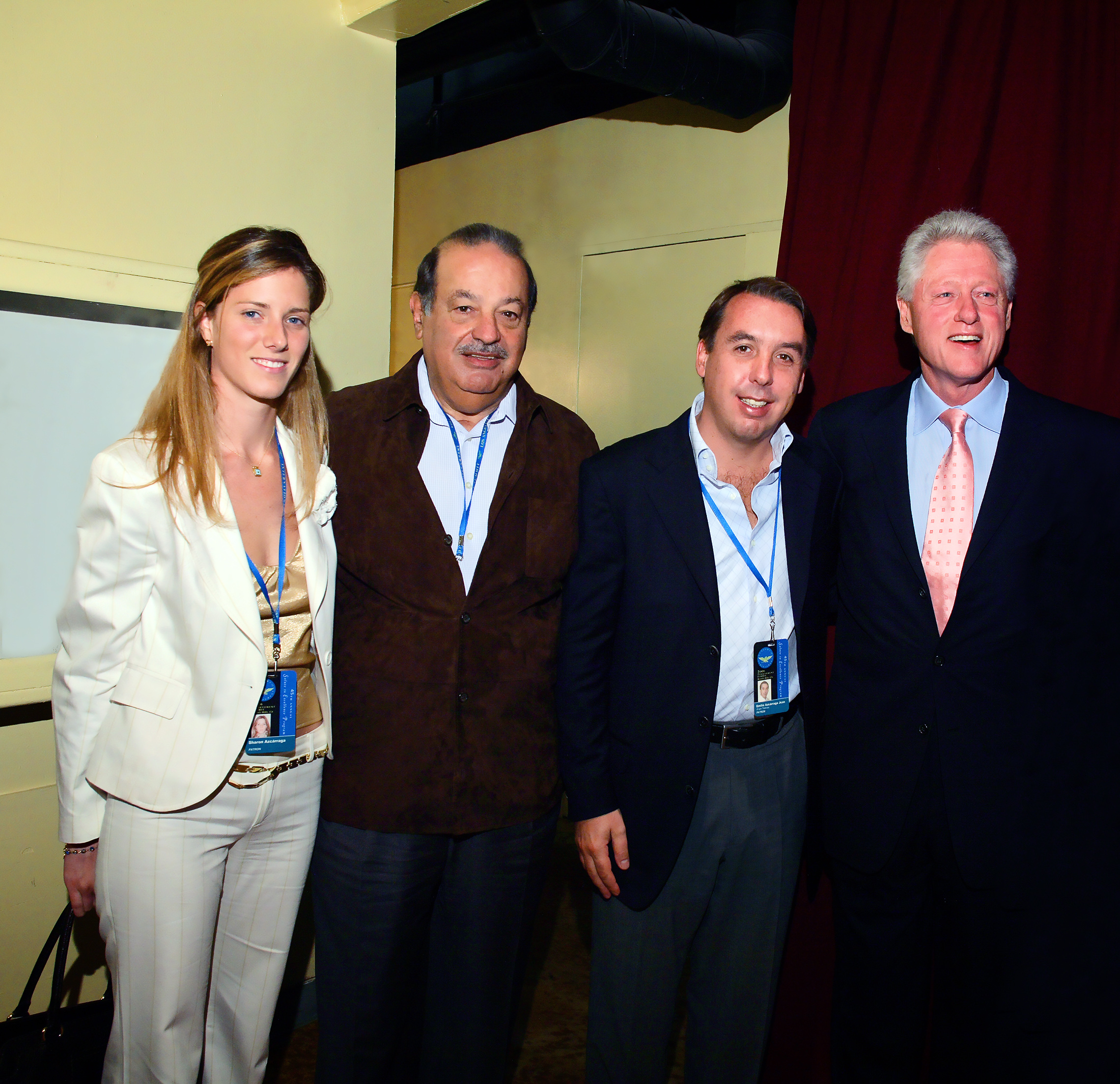
At a 2007 press conference in New York City, Carlos Slim Helú speaks, as former U.S. President Clinton looks on. Slim committed over $100 million to the Clinton Foundation’s Sustainable Growth Initiative for Latin America. (AP Images/Frank Franklin II) Maybe an insurance company isn’t the best example for an entrepreneur getting started in business.
Carlos Slim: Well, in the U.S., it’s beautiful because you have venture capital. When you have a good project and a good proposition, you can find the support of investors. In other areas, you need to find capital from friends or someone that can push the capitalization of business. People that don’t have any capital can begin working by associating, be an associate of one that has the capital. No? You know, there is the joke about one who has the capital, the other has the experience. They lose everything, and now the one with the capital has the experience.
Tell us, what captures your imagination in business and in people?
Carlos Slim: I think it’s not only one thing. Life is the most important thing, that your imagination fly to many places, nature, many things. Many things take my imagination.
And with people?
Carlos Slim: People, concepts, places, ideas also, many things, many things. A curiosity for know things — for understanding other things.
What created that curiosity, that curious mind?
Carlos Slim: I think the interest to know new things, to know better what you know, to know deeper. The more things you know, the more things you know that you don’t know. Curiosity to know people and treat your friends, to go deeper with them, and all these kinds of things, great curiosity in life.
Did your father have that influence on you?
Carlos Slim: I don’t know, but I know that when I was very young, a child, I make many questions, and some people always don’t like that I make so much questions. Now you don’t need to make so much questions, but you can look it for yourself. No? I’m still asking questions. Yes. I still ask a lot of questions.
Do you believe your training as an engineer influenced that, asking questions?
Carlos Slim: I think it was before my studies, when I was a little boy. But engineering is interesting, because you study exact science and experimental science. But I will say that curiosity is beyond the profession I have.
Do you think your engineering training has helped you to evaluate business opportunities and risk?
Carlos Slim: Well, I think talking about curiosity, when you love life, you want to know more about life. I think engineering is important to give you the tools. And in business, to analyze, it’s important to simplify, to have the essential points, the essential issues, the fundamentals, the basics, and take out everything that is secondary, to have less variables to study or to look at. Because when you have a lot of variables, and you don’t make a distinction between the ones that are essential and the secondary ones and parameters, you have confusion. I will say that engineering is important, but also when I was finishing my (academic) career, I make my thesis about linear programming. That’s operational research. That’s to optimize functions, optimize results of things, and the study of models that take you to the optimization of the solutions.
Have you carried out that theory of optimizing solutions throughout your business ventures?
Carlos Slim: I think so. When I was studying that 45 years ago, the parametric linear programming was very interesting, because the problems in the models were the parameters. That’s very difficult to define precisely. The parametrics give you the difference between which solution is optimal. One teacher said that an engineer is someone who makes with one dollar what others that are not engineers make with two dollars.
So has that been a part of your thought process as you look at risk, as you look at opportunity?
Carlos Slim: When you make the evaluation of things, when you look at these kinds of investments, it is very important. I think maybe it is more important than engineering to understand the economy, the macro economy. The macro economy is very important, to know the national accounts, what means fiscal deficit, what means trade deficit or trade superávit (surplus), what means each item, but not only quantitative, but also qualitative. I think economy is very important, to know the basics of economy. To understand what is happening, you need to understand economy. You need to understand the financial statements of the companies, the sectors, and to have world references.
What part of what you do is instinct — which is innate, you were born with it — and what part is experience, a skill set that has been taught?
Carlos Slim: I don’t know. I think that more than instinct, there are circumstances. Experience, I think, is important. To know the whole. I think that from the first moment in ’65, that I founded the companies, I always knew that I’m not an executive. I’m more an entrepreneur. I’m not a person that works from 8:00 to 6:00, or from 9:00 to 5:00. I don’t have the characteristics of the executives. I think in business, you have the executives or the COs, the investors, and the entrepreneurs. They are different personalities.
What is the difference between an entrepreneur, a businessman, and an investor?
Carlos Slim: Well, I don’t know in English. In Spanish, we say empresario , we don’t say businessman. The entrepreneur is more a creator, a promoter, and he works with executives. The executives are the ones who have the work to be done, the organization, a leadership in the organization, but the entrepreneur needs to be the leadership of the leadership.
A really good entrepreneur knows the power of a good idea. A manager knows how to operate, and an investor, how do they know? You are now an investor in many businesses. How do you distinguish that?
Carlos Slim: Well, I think in the small and middle-size business, the same one is all three things. The same person is the owner, is the investor and is the executive. You can’t make a separation in the middle and small business because the entrepreneur has all three characteristics. He is the owner of the business. He is the investor in the business. Sometimes they find partners that invest with them. The investor is one that has confidence in the management and in the economic sector and makes an investment in private companies and in public companies. Mostly, the investor is thinking in middle-term or maybe long-term. He is not selling and buying everything. No? The one who sells and buys all day is like a gambler. He looks for the adrenaline, like kind of a Rambo, an economic Rambo, a business Rambo, financier Rambo. No? They want to feel the adrenaline.
Some very good investors say, “I never buy anything that I wouldn’t want to keep forever.” Do you agree with that?
Carlos Slim: Forever is too long. When you make an investment, it is because you are not thinking in moves from one day to another, except if you’re a gambler or you are playing. When you invest in something, it’s because you can become big with this business, like if it were yours. Not forever. Forever is too long. Some investments are not only for your life. They follow in your family, no?
You’ve been an enormously successful entrepreneur, you’ve been an enormously successful businessman, and you’ve been an enormously successful investor. It’s a rare talent that can do those three things. Aside from your skill set, the tangibles, what about the intangible skill set such as attitude, the ability to read people, the ability to motivate people? How has that influenced your business life?
Carlos Slim: Well, I began to invest when I was — not a teenager — maybe 10 or 12 years old. I learn at those times, how do you call it, when you capitalize interest? Compuesto . Compound interest.
I learned many things when I was very young, maybe 12 or 13 years old. Then I learned how to understand a balance sheet. I didn’t learn that in school. When you look at a balance sheet, there is a lot of information. Not only a balance sheet, but also an estado de resultados . That is a report, financial statement in general. I think finances — to invest, there are some principles that are very clear, but very easy. You invest with basic conditions. You invest when you have confidence in the management, in the sector — you like the sector — and the value of the prices are not high, or are low, low value. Buying intrinsic values in good companies, in good markets and in good sectors. No? I think these kind of things are basics and are not complicated.
The problem is when you want to buy and sell and buy and sell, and that is when the investor gets into gambling, or speculation. That is not necessary, not something rational.
The training I have, for one thing, and the other — to study financial statements during many years, maybe 10 years or 15 years — and my experience in many areas, and the ability maybe to simplify the variables, take out parameters that are not necessary, or variables that are secondary, and look at the essential issues of the business. I really think that I make things that are not very rational, like I get involved with so many, too many areas, too many sectors, doing so many things, so different things. The reason was, when you don’t have an area to grow in one business, you diversify. Thus, I have done really, maybe 50 or 60 different things. I don’t know how many, a lot. That doesn’t make too much sense. It is not a recommendation to others to do that. We have done paper, candies, tires. We compete with international companies, soft drinks, construction, bicycles, mining, the telecommunications, metals, financial services, insurance, and oil platforms, infrastructure to run roads, (collect) tolls, et cetera, et cetera.
We’ve done bakery, retail. I think that’s dangerous. We were relatively successful, but we have got out of some of these areas.
I think it is important to focus in the areas where you — the sectors that you look — with a good potential, that they are part of the dynamic sectors that will grow strongly, where you can do something, where you can do things, and follow world reference. We have competed with many companies. Actually, let’s say in paper, we compete with Kimberly Clark and Scott Paper without a partner, a foreign partner. In tires, we compete with Bridgestone, with Michelin, with Goodyear, without the foreign partner, and we were the leaders in the market. In tobacco, we compete with British American Tobacco. We have a foreign partner. I think that it’s important not only to separate your activities, like an investor and like an entrepreneur, but also to have more focus. There is a moment where you cannot — it is not recomendable — it is not good for others to get involved in so much areas. We have got out of many of these fields. We have sold out many of these sectors because they were too much.
Former Israeli Premier (later President) Shimon Peres, Catherine B. Reynolds and Carlos Slim at the 2004 International Achievement Summit in Chicago. What do you know now about achievement that you didn’t know when you were a young person starting out?
Carlos Slim: I think I understand better the civilization we’re living in. I’m understanding the future better. I have a more clear vision of the future and a more clear vision of the present, and for me that changed many things in life. One of them is a new company that will make efforts to push the development of Latin America. There are many projects, and you need to put them together. That’s what we will do. As you grow older, you have other challenges and this is one of the biggest challenges. I feel that I’m just beginning my big challenges now. These other challenges were in the past, but my big challenge is coming just today, in this age, to accelerate the development of our country.
As much as I look not only at the business environment, but also at what is happening in the world, and how the economy is managed, I am more convinced that many things can be adjusted. Governments should be more clear about what this new civilization is, what it means, what are the new paradigms, what things will happen. The terrible risk we have in this transformation is that during this transition there will be a lot of problems, because people fear change, fear something that they don’t understand. If we don’t manage it very well, it will be very costly socially, economically and to many people it will be terrible.
That’s a big challenge, and that’s something I didn’t know ten years ago, that way of thinking and learning and reading. The last six, eight years I’m looking at it very clearly, and every day I look at it more clearly. Talking with people who were first in these ideas is very important, like Alvin Toffler, and other people that have studied that in a very theoretical and pioneering way.
You have a high energy level and a curious mind, so many things to be interested in, and yet time is your most precious resource. How do you manage your time?
Carlos Slim: I’m not sure that I’m very efficient in managing my time, because all these interests and curiosity take me out of focus sometimes, but time is very important.
How do you allocate that time to business, to family, to your other interests?
Carlos Slim: You cannot do it mechanically and methodologically. Family and personal life is not only a problem of quantity, but of quality. We have dinner with my children every Monday. We get together with all my grandchildren a few times a year for a weekend and things like that. Seventeen grandchildren altogether.
People who’ve known you for years say you’re the same today as you’ve always been. That’s not easy to do with so much success. How do you think you’ve maintained that balance?
Carlos Slim: The real success is not from outside. The real success is not a professional success, a business success, or wealth. The real success is your personal life, your family life, your personal environment. That is your success. The other is not success.
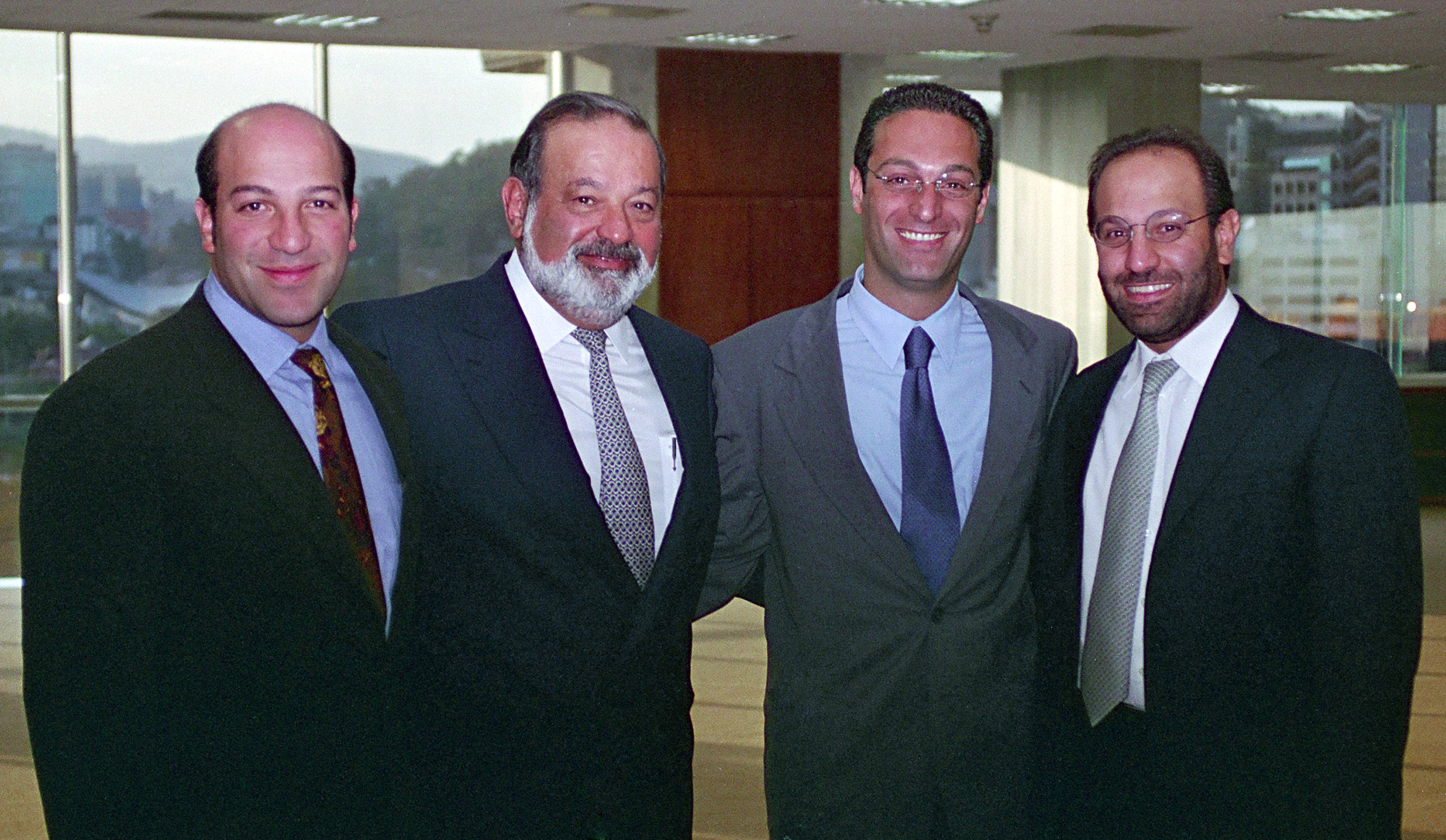
Carlos Slim and his three sons, Patrick, Carlos and Marco Antonio Slim Domit. (Courtesy of Carlos Slim) All three of your sons are involved in your business now. How about your daughters?
Carlos Slim: Three of my children are involved in the business. Two of my sons-in-law are also involved. The other is a great architect. For my daughters, two of them are on the board of directors. One is managing the museum. The other was managing a foundation of my wife’s, called ASUME (Asociación de Superación por México), for personal superación . How we say? To get better. Human development. That’s a very important program, and the other has an institute for children, for early development. They learn to swim very young, two or three years old, as a stimulation for development in physical activities. So two of them are on the board. One has five children.
A lot of times, people who are very successful professionally, fail on a personal level, with their family, with personal relationships. This is not the case with you. You have a wonderful family. You have friends who love you. What is your secret?
Carlos Slim: I think it’s a good question. I think there is not a secret. I believe that family and personal life and business — professional life — is not only compatible. It is necessary. You will have a better professional life with a good personal life and family life than if you don’t have a good personal life and a family life. I don’t understand the contrary. It is very clear that the good personal life makes you stronger. You are stronger for the challenges. You are working. I think I don’t believe in working 20 hours or 16 hours or 14 hours. When you work too much, it is because your job is beyond you. You are not controlling the — you are not doing well at your job. If you need to work 15 hours, 16 hours, this is because you’re not organized. You don’t have delegation of your responsibility, and I don’t believe that in any business, in any activity, you need to work 15 or 16 hours, and you don’t have time for yourself or for your family or for anyone.
You’ve also created a program where fathers and sons from all over Latin America come together for a weekend. Will you talk a little bit about that?
Carlos Slim: We began making it in Mexico, these meetings. We’ve already had six or seven years of doing that. They invite many important businessmen from Latin America with their children, with their family, and there are — we are like 200 that get together, and we have — it is clear that you live socially also, but we make presentations about different issues and global companies, family companies, social problems, et cetera. It has been very successful. We are very happy with that, and I think one of the main reasons to say that is that we’ve had seven meetings. In this new meeting, it will be in Central America. The first was in Mexico. We organized that, and we invite there, the second in Dominican Republic, then Brazil, Buenos Aires, Santiago, and Panama. We have some propositions now in Panama. We have talked a lot about that work already in some of these areas. We are thinking to make a confederation of foundations, of Latin American foundations, to get together for some programs, some projects, to have information what one do and the other, to try to work more together, the foundations. That is one interesting point. And I think we will create maybe also a fund, between the businessmen in Latin America, for Central America, to invest in infrastructure, physical infrastructure.
It seems one of the themes of your work is helping the younger generation to understand their responsibility in the world.
Carlos Slim: We learn from each other, but it’s interesting, because in some areas, the old men, the fathers talk, and the others, the “children” talk — they are 30, 35, 40. Many are in charge of the business, and we learn off each other. It doesn’t matter, the generation. It’s clear, the energy of the young people, also of the old people, and we compromise, and they are very clear about the social responsibility of the business community.
Carlos Slim with his sons, daughters and sons-in-law. At last count, he had 17 grandchildren as well. (Courtesy of Carlos Slim) What’s the most important thing you’ve learned from your children?
Carlos Slim: Oh, it’s difficult to answer. The most important? I think the love between them and between the family.
And you see that with them and their children?
Carlos Slim: Sure. Yes.
It must make your heart fill up.
Carlos Slim: Yes, very happy.
Many people are so spoiled by professional success that they lose who they are. You’ve always been who you are. You’re the same as you were 30, 40 years ago. What do you give credit for that?
Carlos Slim: Education, I think. By example. The example of my parents, and of my children also. My father died when I was 13, and our house was very different than the house I have now. I never knew that my father was so successful when he was 20, 25, 30 years old.
You have an inner being that gives you strength about who you are, from your history, tradition.
Carlos Slim: You need to be very strong inside yourself, very convinced about that. When you need others to say good things about you, you will have a problem, because that has no end. If you need others to say, “Oh, that’s great!” there is no limit.
You started as a teacher. That suggests you not only value education, but that you enjoy mentoring, teaching. Was it different to mentor your own children?
Carlos Slim: No, I think it’s not a difference. I think when I was 19 or 20 years old, I had the opportunity to be a professor in the national university. In the school where I was studying when I was in third to fourth grade (year), and it was a very important experience. I enjoyed it a lot. The class was algebra. It’s nothing that you can make more than academic. Because I believe in academics and in formation, formation of the students and the people. I think for the education of your children, it’s very important, the experience you can have. You can remember what you felt, how you thought when you were a child about things while you are talking with them. I believe that it’s very important, a good relationship with them, especially if they’re going to follow what you are doing. In my case, my children like the entrepreneurial activity and the business activity, because from when they were a child, they weren’t incompatible with my family and my life. No? And I’m very impressed that they manage very well this personal life, family life, and the business activity.
You set a good example.
Carlos Slim: I think they are a good example. I believe that sometimes, more than educating our children, we do something like domestication, “Don’t do that. Go there. Put that there. Take that out,” like we’re training them, without any common sense or rationality, without formation.
So in mentoring your children, you tried to help create a good thought process, so they could understand, analyze, come to conclusions.
Carlos Slim: Sure. I think it’s important to leave your children a better country, but it’s maybe more important to leave your country better children, first of all. And second, you’re looking for the happiness of your children. I think that work is not only social responsibility, but it is an emotional need. You need to work. You need to do things. You need to be active. You cannot be lazy. Without doing anything, it is bad for your emotional health. No? I tried to educate (my children) and that was the lesson from my father also, about responsibility and compromise, because wealth is a responsibility and compromise. When you die, you don’t take anything. You are a kind of temporary manager of wealth.
Of all the business endeavors that you have been involved with, do you have a favorite?
Carlos Slim: I don’t think so. If I have a favorite it’s the challenge in the moment. My challenge for the next seven years — first, three years, and then seven, the first step for three years and the second step seven, a challenge is to create the human and physical capital in our countries, in Latin America. That’s now my challenge. That is what I am more involved and interested in. Health, nutrition, health education and jobs and physical infrastructure. That means airports, ports, roads, highways, power plants, energy, telecommunications, et cetera, and housing, and that’s what I am trying to do within the last years. I left my boards outside Mexico and in Mexico, and I’m concentrating in this challenge, to look how our countries have more human capital and physical capital, trying to help that and to support that, by looking at it through the foundations that I create and through the investment. I believe that poverty is not fought with donation of charity. You cannot fight poverty with debt relief donations and social programs. You fight poverty only with a good education and jobs. Jobs is the way to fight poverty, and in the past, the problem of poverty was an ethical problem, a moral problem, a problem of social justice. Today, in this new civilization, to fight poverty is an economic need. If you don’t fight poverty, the country doesn’t develop. In the past, you have slaves. You fight for earth, for soil, and people work for nothing. Now you don’t need the physical labor. You need mental knowledge, labor that knows training, skilled labor, and that’s why you need the education and the human capital. That’s what I’m convinced of, and that’s what I’m working for. That’s what now I am most interested in.
You went from creating businesses that can function on their own, and now you have a larger purpose in the world. Was there a moment when you saw that change in direction?
Carlos Slim: No. It’s a process. Always, always. It’s very clear for a long time. The foundation has 20-something years. Fundación Carso is a very old foundation, and that is the way we formally begin to do that. Now, what is clear maybe a little bit more, I believe that the skills, the training of the entrepreneur are very good to solve social and economic problems. Not because you have economic resources, or material resources, but because you know how to manage these resources. You understand how to solve problems. In business, you constantly have problems and problems and problems, and you have a great training for that. When you look at some of the things that are happening in our countries, in all countries, but currently in our countries, you say, “Well, that can be done this way and this way and this way,” and if you have the human resources, material resources, a team and the skills and the experience, I think it’s a very important and great thing to do.
Carlos Slim and former U.S. President William J. Clinton, in conversation at the 2004 International Achievement Summit in Chicago. Entrepreneurs are always looking for innovative ways to do something better, so the entrepreneur’s approach to social problems is trying to create better solutions for public problems.
Carlos Slim: That is exactly what I think, but also, it’s clear that government is not enough. There are not enough resources. The PPPs, public/private partnerships that involve private investment are getting more popular, as in England not many years ago. All the governments, including the most radical, believe in private investment in some way. You need the combination of private investment and public investment, because public investment is not enough to solve the problems, and the innovation that people with business experience can bring is very important to solve these kinds of problems.
There’s another point that I think is very clear. Governments, as much as they can have labor, they can’t provide more than ten percent of the labor. The economic activity is like 40 percent of the population. The government will solve only a small part of the employment, and private investment, big business are not solving the problem. You need to develop small business, take down the business mortality, like we kept down the child mortality. You need to take down the business mortality, and promote small and medium business. There are a lot of jobs there. Promote health and promote entertainment and promote education, and you will have a lot of employment there. Finance them, because the problem is overregulation and financing, and we’re beginning to create some concepts of financing a small business. Let’s say in Telmex, we’re going to finance our customers, just because they pay regularly. We are going to finance them for two years or three years, without so many papers and information and documents, more expedito , more easier, more quicker, and carefully.
You know what we’re doing now that’s very interesting, reconvercion , changing urban areas. Like some old factories, we make them into shopping centers and cultural areas. There is a big area that used to be a garbage area, and now there will be public sport places, universities, hospital, shopping center and a big development there. No?
What about your restoration project in Mexico City?
Carlos Slim: Downtown. Centro Histórico . That was very important. The project was not to restore, but to revitalize. Revitalize means to have life again, more people working, living, studying there, and entertainment. That gives you life again to downtown.
Then it gives new jobs. People make more money. The economy goes up. They invest in education, their home, everything. Exponential.
Carlos Slim: That is a change that can be done very fast. Before that, there were years and years trying to revitalize, to restore downtown, and in three years, we make the change.
The private sector did it better than the government.
Carlos Slim: Yes. And if you make it in combination with the government, it is fabulous.
Isn’t it hard sometimes to partner with the government?
El Centro Histórico, downtown Mexico City. Once a run-down scene of urban blight, it has been restored and revitalized through an innovative public-private partnership led by Carlos Slim. (Courtesy of Carlos Slim) Carlos Slim: No. You don’t need to partner, but let’s say something like México histórico . The government needed to put in security, they needed to train new police. We put in security cameras. We put a place where the cameras were controlled near the place to have immediate action. The city government changed the streets and the drainage and some of the public services, and the federal government brought the Office of Foreign Affairs back to downtown and there are a lot of people working there. That ‘s what we needed. The university also has a lot of buildings there. They have more activity in downtown. They took some offices there.
Has that model been attempted in other Mexican cities?
Carlos Slim: Other cities have done a good job in the restoration of these historical centers, and we have contact with them. São Paulo (Brazil) also wants to do the revitalization of its downtown. The concept that I have for this future challenge comes from that experience downtown, from Centro Histórico . That was a combination of the foundation to take up the economical and social level of the people living there, and investment. That’s why I told you, you need foundations and investment to fight poverty. To give employment, you cannot give employment with the foundations. You need to give employment by investment, companies that invest in roads, in housing, in many areas. No?
How do you want to be remembered?
Carlos Slim: I try not to think about that. What I worry about is the future of my family, my sons, my grandchildren, that they get together, that they love each other, that they can be positive for themselves and for the society. That’s my worry. I don’t worry about being remembered in one way or the other. I will be remembered very well by my children and my friends.
You know, what I told you about the new civilization is really very important, because things can move and faster than what we’re thinking. We can push them to be faster, and an ordinary evolution, and not with crashes and problems and social turmoil or problems.
We seem to have more than our share of turmoil in the world right now.
Carlos Slim: Yes, but this turmoil is bad management. I have an example of this.
When the civilization began, when the agriculture was discovered, it was because glaciation was finished and there were a lot of paradises. A lot of paradises with a lot of water, a lot of animals, fauna and flora in excess, and people that was nomads get sedentary there, and as they get sedentary they begin to think, but they don’t worry that 50 — from 50, 30 he has no job, or 40 he has no job. That was not unemployment. There were no troubles in the change. They begin go up very soon, to look for sun, to look for housing and look for clothes and to look for organizing other things, et cetera. But now that technology is creating so fast, so well, so much wealth, we don’t know how to manage that, and we have unemployment and we have poverty worse, and it’s a problem of management, of organizing the production of wealth that is like never before so efficient, so fast, so many goods, so many services, so low cost for do everything. But creating wealth you have the paradox of higher poverty. That’s stupid.
Perhaps you need to develop a course on the management of wealth.
Carlos Slim: Management of wealth. That’s also important but I think it is more important than that. It is more important. But the other point is that…
In the past, in the agricultural civilization, 200 years ago and more, all the power was in the hands of the monarchy, the pharaoh, the tlatuani , the emperador , no? And as much as it advanced, the power is in the society. Not only in the private sector that has more things to do, but all the society, the non-government organization is every time taking more, the academics, the newspapers, the media is taking more of the area. What should be done is more faster and organized. And the private sector is more efficient — a businessman and an executive, a private executive — than a public executive, and the politics by definition. All this shall be changed somehow. But like I said, turmoil is getting worse in many places because of the fear of change, the fundamentalism, the change of the paradigms. They are not clear. The paradigms are different. They put the globalization like the cause of the problems. Globalization is only one of the consequences of technology. Globalization is part of communication. You move from the speed of the horse and steam engine to the speed of light. Technology is what is making the difference. Unemployment doesn’t come from globalization. It comes from technology. But technology creates a lot of wealth and a lot of productivity. What you need is to find how you motivate other people to be involved in the economy and in life and unemployment. I think we’re doing it very good. Very good is China. China is getting into the new civilization in a way and the timing they like. Doing it very fast, but thinking very long-term.
They’ve also created a huge gap between rich and poor in China.
Carlos Slim: It doesn’t matter about the poor and rich gap. There is a Chinese proverb that says “Bad governments worry about the rich. Good governments worry about the poor.” What they’re doing is to move from a rural and agricultural society to an industrial society and to a “new civilization” society, but they can’t do it from day to night and night to day, day to night. They’re doing it with long-term planning, very fast. It may take two generations, but they’re doing the right thing. Before, everyone was poor.
When you think of your legacy, will it be one of business or one of philanthropy? By philanthropy, we don’t mean just giving money away, we mean creating a new paradigm to address poverty.
Carlos Slim: I think both are important. Actually, the idea of develop human capital and physical capital needs — some areas that are not profitable, you need to have the foundations — but where it is profitable, it is important that physical infrastructure is profitable. It will be investment. I think the combination of both is very important. Both are fundamental to the development of our countries, to fight poverty and to break the barrier of underdevelopment. I think you need to arrive to some kind of income per capita, some level of income per capita that is like a speed to break the barrier of underdevelopment. Like to get out of the air, you need some speed to break the gravitational forces. You need a revenue per capita to break it, and I think many of our countries are near that. I think investment is very important, because employment is made by investment. So you need to invest, and businesses need to invest. Businesses are necessary to give employment, and by the other side, what is not profitable — or short-term profitable — should be supported by foundations, like human capital, the health of the people, nutrition. Then they work together I think.
In addition to that, you believe culture and the arts play an important role.
Carlos Slim: It’s human capital. Culture and arts is where we are more advanced, but you also need to take care of the environment. Medioambiente , we say. Environment, ecology. Arts, entertainment, sports also. We’re also working in sports. That’s human capital, human and social capital, to have this kind of support of these activities by the private sector.
Rodin’s The Thinker on display at Museo Soumaya, named for Carlos Slim’s late wife, Soumaya Domit. (Courtesy of Carlos Slim) It addresses the human spirit.
Carlos Slim: Sure. It addresses it and makes stronger.
Right. You created a museum, named for your beautiful wife. She loved the arts.
Carlos Slim: The collection was owned by me, but she was really, really, very sensitive to the arts. I learned a lot from her. She was really very sensitive and very profound and loved art and the beauty of things.
People say that art fills a spot in the heart where business or other things just can’t. We take it art filled that spot for you. Yes?
Carlos Slim: Yes, yes. Art, but also nature, the sea, sunsets, the forest, the rivers, the falls.
This has been a wonderful conversation. Thank you so much.
Thank you.