
Once I discovered architecture as a need of my nature, then that enthusiasm knew no bounds... art is the only thing I’ve been alive for. There’s no such thing as leisure time. If your work is architecture, you work all the time. You wake up in the middle of the night. ‘I've got a wonderful idea!’
For more than 50 years, Philip Johnson was one of the most influential figures in American design and architecture.
After graduating with a degree in philosophy from Harvard in 1930, Johnson became founder and director of the Department of Architecture and Design of the Museum of Modern Art in New York, the first museum-affiliated program in the United States devoted to the study and exploration of architecture as an art. It was during his first tenure in the position — he headed the department between 1930 and 1936, and again from 1946 to 1954 — that he and architectural historian Henry-Russell Hitchcock mounted their landmark exhibition entitled “The International Style.”

This 1932 effort, which labeled an architectural style being practiced by such European masters as Mies van der Rohe and Le Corbusier, introduced a generation of American architects to a revolutionary approach to design. Characterized by the use of such modern materials as glass and steel, and emphasizing function and structure over ornamental decoration, the International Style dominated our city skylines for 50 years, and continues to heavily influence contemporary design.

Johnson returned to Harvard at age 34, to study architecture, and after military service, embarked on a distinguished career as a practicing architect. In addition to promoting the theory of the International Style, Mr. Johnson was credited with creating some of its major monuments, including the Seagram Building (in a collaboration with Mies van der Rohe) and his own famed Glass House (1949), a single room entirely walled in glass, which has been donated to the National Trust for Historic Preservation.

Johnson designed many landmarks across the nation, including the twin trapezoid-shaped Pennzoil Place in Houston, the 51-story IDS Center in Minneapolis and the New York State Theater at Lincoln Center.

In 1967, Philip Johnson formed a partnership with John Burgee. Mr. Johnson entered a new phase of his career with Mr. Burgee, an architect with a reputation for mastering large and complex projects. Together, Messrs. Johnson and Burgee attracted the types of commissions — important high-profile projects, both large-scale and small — that neither, individually, had previously attracted on a regular basis. These jointly designed projects — from Minneapolis’s IDS Center, to the Crystal Cathedral in Garden Grove, California, to the corporate headquarters of Pittsburgh Plate Glass — reflect a distinctive, if not easily categorized, approach to design.

Johnson and Burgee’s design for the AT&T corporate headquarters building (1984) in New York, with its stone cladding and identifying broken-pediment top, changed the dialogue of contemporary architecture just as dramatically as the International Style had 50 years before. Its blatant use of a material that did not reflect the functional or structural realities of the building, as well as the incorporation of design elements merely for their own aesthetic value, ran counter to the tenets of the International Style. AT&T represented a critical watershed: it was the first major built structure that revived the use of historic styles — an approach to design prevalent throughout history but strongly abandoned and derided by the profession during the supremacy of the International Style.

Mr. Johnson was justly celebrated for championing the two architectural movements that most profoundly affected urban landscapes during the second half of the 20th century: the International Style; and the reintroduction of the uses of a wide variety of historic styles in contemporary architectural design. Philip Johnson won the first Pritzker Architecture Prize for lifetime achievement and received the Gold Medal of the American Institute of Architects, the highest honor of his profession.
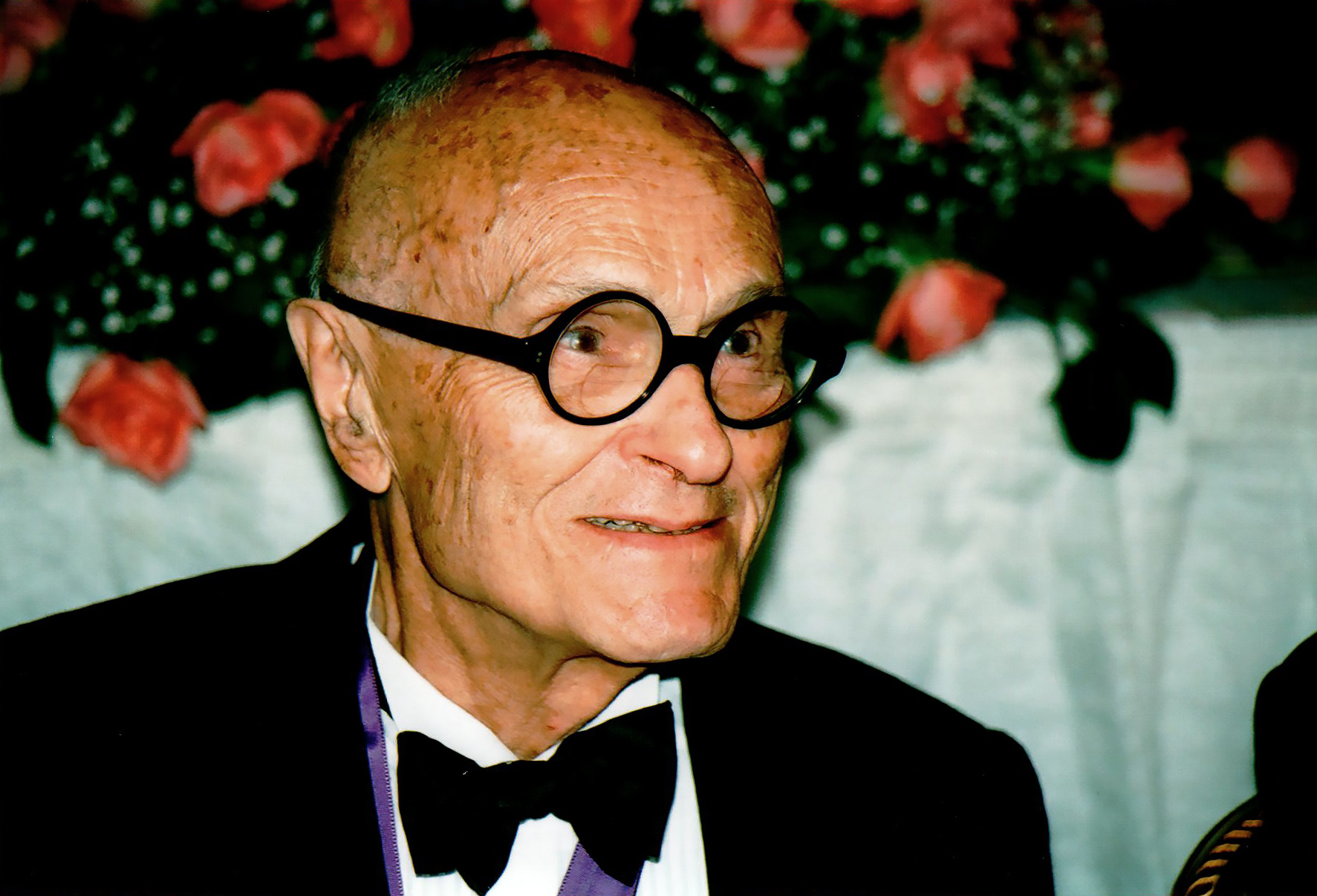
Through his designs, writings, and teachings, Philip Johnson played a seminal role in defining the theoretical shape and literal form taken by architecture in the 20th century. When he died at the age of 98, Johnson’s eminence in his profession was unassailable, but the press took note of a political controversy that had shadowed his career since the 1930s, one he discussed with candor in his interview with the Academy of Achievement. In the depths of the Depression, frustrated with the deliberative processes of democracy, Johnson had been drawn to a succession of radical populist movements and leaders.
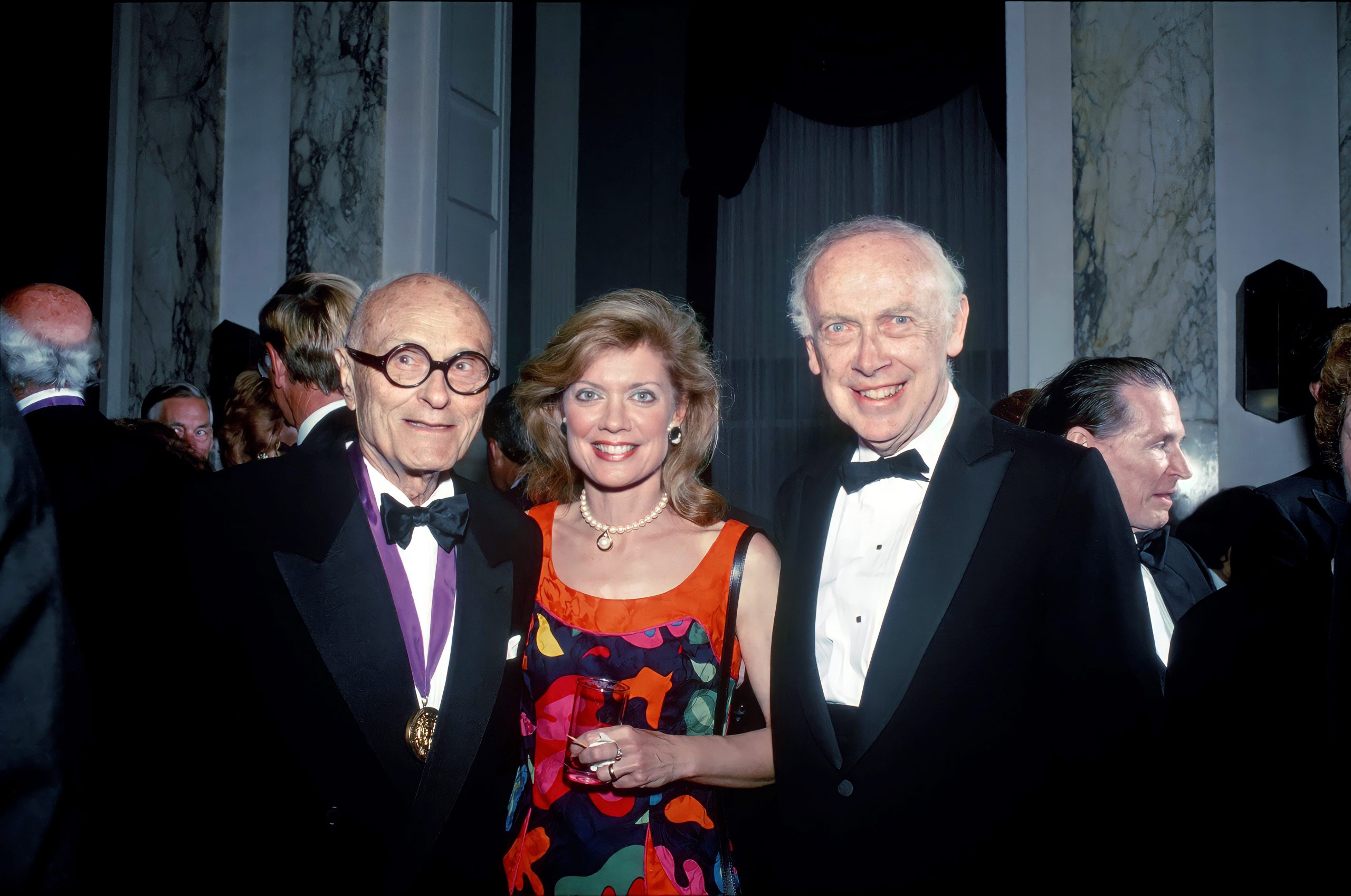
He returned from a trip to Germany full of enthusiasm for Hitler and the Nazi regime. By the end of the decade, Johnson had turned away from these political involvements, and he served in the United States Army during World War II. Although he publicly repudiated his past association with fascism, questions about Johnson’s beliefs persisted. In 2020, a collective of artists and architects wrote to the Museum of Modern Art and Harvard’s Graduate School of Design, requesting that Johnson’s name be removed from facilities and endowed positions that had been named in his honor. Harvard responded by changing the name of the Philip Johnson Thesis House, which Johnson had designed and lived in as a graduate student. Henceforth, the house, which Johnson donated to the university, will be known by its street address, 9 Ash Street.

“To be in the presence of a great work of architecture is such a satisfaction that you can go hungry for days. To create a feeling such as mine in Chartres Cathedral when I was 13 is the aim of architecture.”
Philip Johnson didn’t begin formal study of architecture until he was 34 years old, but he had already made an impact as the first director of the Department of Architecture and Design at the Museum of Modern Art in New York City and as co-author of The International Style, the book that gave a name to the movement that dominated world architecture for the next 50 years.
Not content to be the foremost American publicist of the movement, Johnson soon became its foremost American practitioner. Throughout the 1950s and ’60s, Johnson delighted some and outraged others with sleek modern designs like those of his celebrated Glass House in New Canaan, Connecticut, the Seagram Building (a collaboration with his mentor, Ludwig Mies van der Rohe) in New York, and the Crystal Cathedral in Garden Grove, California.
In his 70s, with a long, successful career behind him, Johnson shocked critics and colleagues alike by a sudden shift to the new “postmodern” style associated with a far younger group of architects. Johnson’s design for the AT&T headquarters in New York City is one of the most celebrated works of the new school.
When he was young, Philip Johnson dreamed of writing the history of architecture, and so he did, but who dreamed that he would make so much of that history himself?
You could not have graduated from college at a more challenging or unsettling time. It was the start of the Great Depression. What were those days like?
Philip Johnson: Tragic. I didn’t see how art fit in. It was too close to me, the farms and people in debt and people plain hungry. You wouldn’t believe it was possible in this country. Roosevelt didn’t seem to be doing enough, although I voted for him six times… no, he didn’t run that many times… but he was a great man. So art was not so important in those years, all of the ’30s.
What were you looking for during that time?
Philip Johnson: Hero worship. Speedy solutions. I didn’t see why we shouldn’t get things going instead of dithering all the time and talking so much. The first time I joined any political thing was a milk strike in Cleveland. My farm was nearby and I fought with the farmers against the milk companies. Took radio time and made talks. Was finally threatened off the air by the milk companies. They got to the head of the station and said, “Don’t sell that man any more time!” I hit a nerve anyhow. I had fun. I doubt if I helped the farmers much.
My hero worship got around to Huey Long. That’ll surprise anybody, because Huey Long is a forgotten figure, a populist from the South who wanted to save the world from Roosevelt and from the Depression. Things were bad in the ’30s. That I couldn’t stand. I said, “What is it? We’ve got plenty of wheat and grain and trees, and why is there hunger?” Of course there was in those days. This depression hasn’t gotten to that stage yet. But that was bad at that time. So I said, “What do I do about it?” I didn’t want to be a communist, which seemed to be what one’s intellectual friends did. So instead, I became what was later called fascist, but it wasn’t in those days; it was populist, and Huey Long was going to fix everything. So I drove down and met Huey and said, “What are we going to do?” And one of his people said to me, and I’ll never forget this, he said, “How many votes do you control?” I was only asking whether I could even work with the man! In other words, he was so individual and chaotic that there was no way of getting along. So I came home and he got shot and that was the end of that. He was quite a figure.
What about Father Coughlin?
Philip Johnson: He was my substitute for Huey Long. Father Coughlin was more of an intellectual, of course, but also not as basic, not as good.
What was the worst mistake you ever made?
My worst mistake was going to Germany and liking Hitler too much. I mean, how could you? It’s just so unbelievably stupid and asinine and plain wrong, morally and every other way. I just don’t know how I could have been carried away. It’s like being carried away by a religious revival or something that enables you to cut people’s heads off in the next county because they live in the next county. That’s not good either. But that I should be psychologically so inept as to be swept along in something so horrible, it really wonders you. How could you? I never found a reason, I never found an excuse, and all I can say is how much I regret it because the racial part of it is the worst. I can understand social fascism as done in Italy before Mussolini met Hitler, because that was, “If the trains run on time, let’s not do it the communist way, let’s do it our way.” That made some sense and that’s what I was doing here in America. But to be caught up in the racial thing was unbelievable, because like everyone else in the intellectual world, nine-tenths of the people I know are Jewish and the outrageousness of that kind of thing that could happen in a world and I didn’t know it? Where the hell was I? A Harvard graduate! So much for Harvard! I was just stupid. Just unforgivable. That’s the worst thing I ever did.

What lessons do you take away from those experiences in the ’30’s?
Philip Johnson: I put it out of mind. That’s what I like, is causes. I always overreact. If I go religious, I go on my knees for days, that kind of thing. That was a very short interval, but the cause was a good one. Once I discovered architecture as a need of my nature, then of course that enthusiasm knew no bounds and it’s been the same ever since. The turning point was 1939. And ever since then, art is the only thing I’ve been alive for. I spend my waking hours. There’s no such thing as leisure time, for instance. If your work is architecture, you work all the time. You wake up in the middle of the night. I got a wonderful idea last night! Still working in Berlin on one of those things, and I know just where that window is going to be. I’m varying between that shape and this shape. I enjoy it more and more all the time. I’ve got to hurry now.

What made you want to be an architect?
Philip Johnson: I don’t know. Because I couldn’t do anything else probably. I wasn’t very good at anything. I couldn’t draw, and I was mostly interested in ideas and politics and world events.
My mother was interested in architecture. She wanted a house by Frank Lloyd Wright when she was young, but my father didn’t see it the same way, naturally, for obvious reasons, so we compromised by not having one. I suddenly realized in the middle of my political work — ran for the local state legislature and didn’t want that. It didn’t work at all. I was a lousy politician, terrible, had stage fright, everything wrong. I was like certain candidates for mayor in New York, but we won’t go into lots of things. So I said, obviously, I had missed my calling. So at the age of 34, I decided to really be serious about architecture. So I went to Harvard at 34. You see, my problem always was I couldn’t draw, so I knew I couldn’t be an architect. Harvard didn’t care whether I could draw or not. It seemed like a good idea. By that time, I’d worked for some years at the Museum of Modern Art on architecture, so I decided what the hell, I might as well be one.
I majored in philosophy at Harvard, and I didn’t know if I wanted to be a teacher or a theoretician or just what, but I was always interested in art and architecture to look at. I was mostly interested in ideas and politics and world events. So I suddenly realized — in the middle of my political work — I had missed my calling.

What about your meeting Le Corbusier and Mies van der Rohe? How did that influence you?
Only Mies influenced me. Le Corbusier I met. He was a nasty man, but obviously a genius. You don’t have to like the people just because they’re geniuses. Mies and I got along better and we became pretty close. I worked with him on his greatest building here, the Seagram building, which was kind of fun, but again, you can’t be a hero-worshipper and be an uncommon architect; you’ve got to be your own man. So I split with Mies and did a different kind of work.

The Glass House has been called one of the most influential designs of this century. Why?
Philip Johnson: I don’t know. I didn’t know it was. It’s the most photographed house. Bothers the hell out of me. I’m supposed to live there and then people come and look at you all the time. It’s annoying. I don’t think it is. That was the time when I was working with Mies. Mies’s ideas are perfectly clear there, of using nothing but glass for the walls. Seemed the natural thing to do. Most people didn’t think it was so natural. As they said in the local papers, “If Mr. Johnson wants to make a fool of himself, why doesn’t he do it in somebody else’s town?” Oh dear. Of course, I enjoyed all of that. I enjoyed the battle. But the house itself? I don’t know. I can’t imagine.

How important is the battle and the struggle? Can you create without it?
Philip Johnson: Maybe I can’t.
Maybe the battle is the thing. Like a horse in wartime, it smells the gunpowder and gallops off to war. Maybe it’s the charge and the challenge that makes you work. That’s why you can’t talk about these things. It’s just that it satisfies something needed for living that nothing else will. And the best days in the world today are spent alone in my study with a piece of paper. Great satisfaction. In the evening I can relax and watch Dallas or something.

You’ve designed buildings from the Glass House to the Crystal Cathedral to the AT&T building. Is there a difference between designing a house and designing a skyscraper?
Philip Johnson: It’s more difficult. Because every decision you make makes such an enormous percentage difference in the looks. If you get a good plan on a skyscraper, you’ve got to get somebody’s computer — not mine — and click it through and it reproduces all the plans all the way up to the hundredth floor. So you have a few basic decisions and then the battles begin. Because if you get into that kind of money everybody has something to say and everybody knows better than the architect. Every kind of consumer becomes a part of the business. You never know what’s going to open up next to stop your design. AT&T! The battles! It’s lucky it came out as well as it did.
There certainly was controversy with that.
That’s peculiar, isn’t it, because there’s nothing very strange about the building, do you think? I shouldn’t be asking you. It looks pretty ordinary to me. I put a funny top on it. But not funny, people call it the Chippendale top. I didn’t know about Chippendale at the time. I see now what people mean, but I didn’t know. It was just a way to end the building that people would notice and would decorate the building so you’d know it from other buildings, with a cut-off, like that. You don’t miss the building if you never see the top, but that’s natural to make a building be seen. The Chrysler building — wonderful top. They spent all their time on the top. There’s no middle, just dull windows. But with a top like that, that’s going to be a monument for all of history. So I thought I’d like an interesting top. Boy, my friends in the company weren’t as pleased as I was, but we got it. They wanted a new way of looking at the world. I said, “Well, this is different,” so we built it. Seagram’s was just the opposite. Mies had the confidence of the owners, and he built it, and it was their idea, to build it in bronze. I mean, there cannot be anything more expensive in the world than bronze. You notice it’s the only one, but they said, “Fine. If it’s the finest material, let’s use the finest material.” So that of course was a very pleasant job.

Was there an event, a moment early on that influenced you?
Philip Johnson: Yes. I was a young man, much more inspired than I thought I was. You don’t know what you’re doing when you’re young.
You get very excited about something but you don’t know you’re getting excited about it and you think everybody’s the same way. I don’t see how anybody can go into the nave of Chartres Cathedral and not burst into tears, because I thought that’s what everybody would do. That’s the natural reaction I had. That and the Parthenon — one in 1919 and one in 1928 — gave me the realization that I had to be in architecture in some way. Those events were sort of a Saul/Paul conversion kind of a feeling that determined me to play some part in architecture. So when I joined the Museum of Modern Art in New York City, I started the Architectural Department and worked there for some years and wrote a book. When I went to Harvard, it was taught in the school, so I was allowed not to take that course. It was very funny.

How old were you when you saw Chartres Cathedral for the first time?
Philip Johnson: I was 13. So I thought, my goodness, if a kid like me can get this excited, I didn’t think it was anything unusual. Mother didn’t either. She was interested in art, she took me (to France during) the Versailles Treaty years, and I remember saying to myself, and I wrote it later in letters, that if I lived in Chartres, I would turn Roman Catholic to enjoy that cathedral, and if I turned Roman Catholic, however, I would go and live in Chartres. Because how else could I exist without this closeness to this particular thing?

You say you had a powerful reaction to seeing the Parthenon as well. Could you tell us about that?
I first saw the Parthenon in 1928. By then I knew more about architecture and the history, but the actual presence of those stones was entirely different than the books. If you’ve just seen pictures of the Parthenon, you haven’t the slightest idea of what it is. But to be on that particular hill, with the other great hills around you, and be standing with those stones practically in your hands — because a lot of them are falling down — was an experience that was second only to Chartres. I wrote an article at that time saying there was a pre-Parthenon Philip Johnson and a post-Parthenon Philip Johnson, because that was the strongest single point of my learning about architecture. I was already 22, I should have known more. I should have known in 1922 when I was 17, 18, that I was going to do that. But I thought everybody did, so I’d do what I was interested in at that time, which was music, philosophy and the Greek language. I thought one of those three I was going to be into. I had this terrible thing happen to me at the Parthenon, but it wasn’t until I was 34 that I had sense enough to go and get my education. Education’s terribly important. But at the time, I would have none of education. It was all feeling and being converted to a dedication.