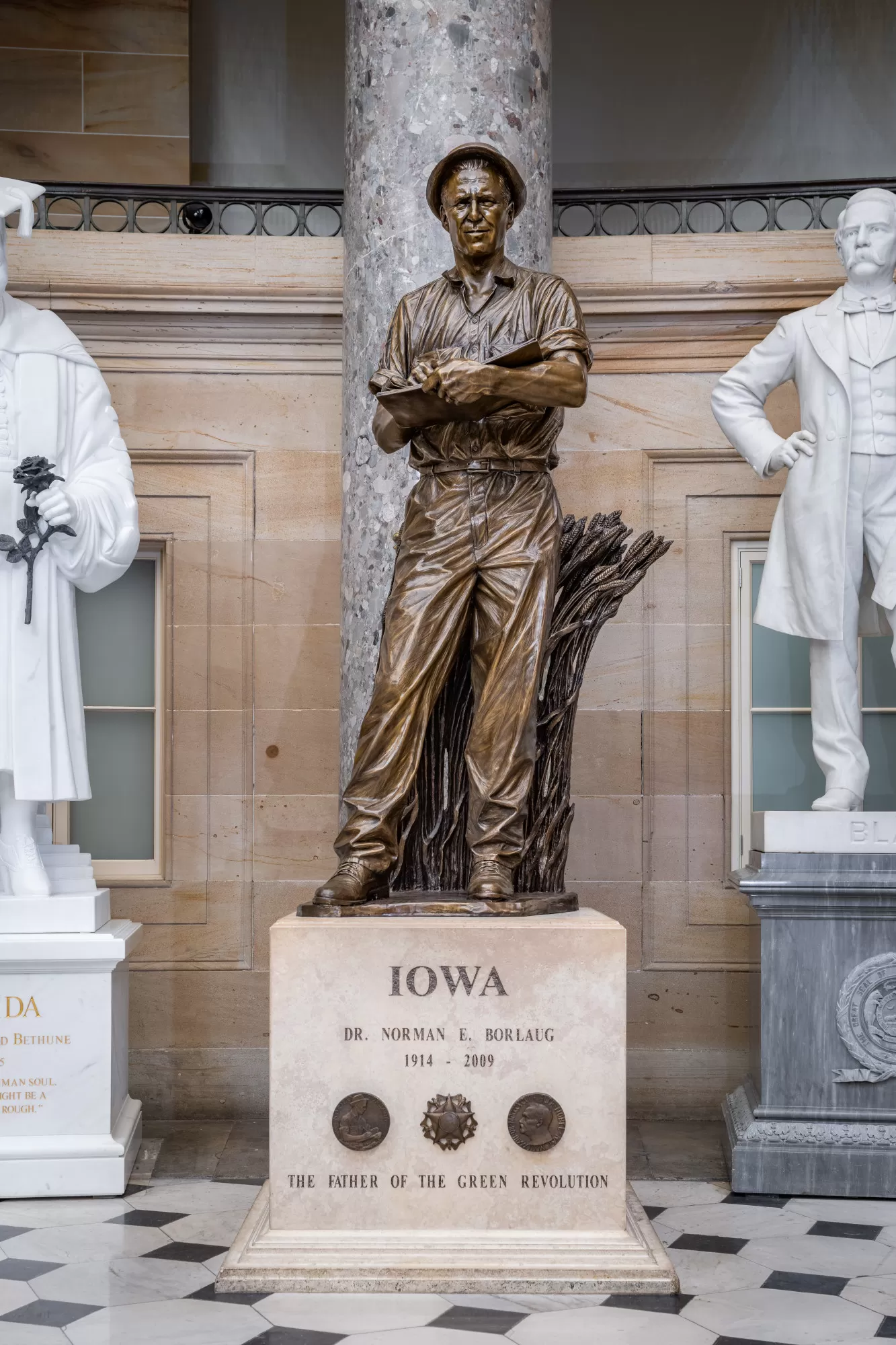
You encountered some political obstacles at first, and petitioned the Planning Minister of India, Ashok Mehta, and President Muhammad Ayub Khan of Pakistan for some policy changes. Can you tell us about that?
Norman Borlaug: I think in the case of Ayub Khan, the President, he came from an agricultural background as a boy in the hills of western Pakistan bordering with China. So he understood what the significance of these kinds of yields were. And the Secretary, I knew him personally, and I sent him a lot of these small samples. And he had seen those demonstrations also. It might’ve been in the spring of ’64 — somewhere around there.
He had seen those demonstrations. He was a forester by training like I was, but he saw those changes that came about with the varieties and the fertilizer and their right rates of planting. So when I was there the next spring, I met him in the hall, and he had a box under his arm — a little box. And he said, “I’m glad you came this morning because I’m leaving for China this afternoon.” And he said, “That little box I’ve got here is a small sample of all of your wheat.” And it took me a long time to find out — and it’s not documented even now — that the first commercial wheat of the Mexican type that went to China came from Pakistan.
What were the policy changes you petitioned for?
Norman Borlaug: First was credit to permit the little farmer to buy the new seeds and the fertilizer. Then flexibility in agronomic practices — when to plant and how to plant — and then a change in policy as it relates to the whole system.
What about the market value of the wheat at harvest?
Norman Borlaug: They used to say the Mexican wheats were a bad quality. So automatically they would dock them ten percent. It wasn’t true because Eva Viegas, our biochemist in the Office of Special Study, she was checking all of those things. But you get that into the literature and everybody believes it, if it comes from one of the most progressive parts of the government.
Is there a part of you that enjoys the fight? This struggle with politicians and nay-sayers?
Norman Borlaug: Sure. Sure. Otherwise, I would’ve given up a long time ago when Paul Ehrlich and the Paddock brothers were saying you can’t do anything in India or Pakistan because of the population problem.
What is it that you enjoy about that fight?
Norman Borlaug: Change. I say that the only way that the world can keep up with food production to the levels that are needed with a growing world population, is by the improvement of science and technology, and with the right policies that permit the application of that science and technology. And that includes availability of the improved seeds, fertilizer — how much of each kind of nutrient — and the control of weeds, which is very important, and then, finally, this whole question of credit and policy on pricing. All of those have to be part of the package.
We had the good fortune in Pakistan of having a person who was really not supposed to be working in agriculture. Haldore Hanson was the Ford Foundation country representative. Ford Foundation at that time was not working in agriculture. They were beginning to collaborate in India with the Rockefeller Foundation. But in Pakistan, no. But here was Haldore Hanson when we had demonstrated how much improvement you could get in the yield. He brought in from Mexico Dr. Ignacio Narváez, my most trusted, most experienced Mexican who had grown up under the system. He had an unusual economist, Oddvar Aresvik, a Norwegian who was different from the rest of them because he wanted to see what happened with these different treatments. So he actually went out and looked at those demonstrations and he saw the errors that were being incorporated, and so he was strongly supporting Narváez and Hanson.
And Hanson, the only way he had to get into production was through this demonstration. So he, Narváez from Mexico, and Aresvik the Norwegian economist, and later Bob Havener. The Ford Foundation damn near destroyed the program, when you could see everything was ready to unfold. They sent Hanson as the new director to Nigeria, and they sent Narváez and Aresvik and Havener, who later became Director of CIMMYT, to Lebanon to start the program of dry land.
Around 1965, you started some testing in India and Pakistan. You had 250 tons of seed varieties sent to Pakistan and 200 tons sent to India. Is it true those shipments had trouble getting there from Mexico?
Norman Borlaug: Even before they left Mexico. The organization insisted that this was the first time that a commercial operation was taking place, and that their seed organization, the Semillas Mejoradas, had to enter into the operation, because it was government-to-government. This organization was notoriously bad for producing seed that had bad germination, mixtures of varieties, but they got the contract.
Wasn’t there some trouble at customs?
Norman Borlaug: There was trouble. I thought my boss, Dr. Wellhausen, was away on home leave, and he said, “Norm, you’ve got to stay in the office here and not be running up to Sonora now with all of this, because the whole program will depend on what you do here.” And I said, “Yes, sir.” But when all of the trouble started happening in Sonora, I just went up there, see what I could do, find out the facts. And when the seed arrived, it arrived too late. It was shipped from a coöp in Hermosillo, not in the Yaqui Valley, because the harvest was finishing when we got noticed from ship to seed; so it came from Hermosillo. We ended up with bad germination. The seed arrived too late for us to run germination tests because it arrived in the middle of December. We wanted it the middle of October. So we planted without germination tests. I was in southern Pakistan and Narváez was in northern Pakistan, and a few days after planting, we were digging and we saw something was wrong with the germination. So we told the ministers to double the seeding rate, and of course that doubled the cost.
What was the problem with the seeds?
Norman Borlaug: The problem with the seed was that in the same warehouse they had commercial grain seed, and they used the dosage of methyl bromide, a fumigant, for a commercial grain, which raised havoc with the germination of the experimental wheat coming out of the same warehouse. Of course, in this period, from the time we shipped in the first semi-commercial quantities of seed to Pakistan and India, there was many things that went wrong. Very few of them went right. Delays in shipment from Mexico, even though I thought I had arranged it all at the border, the Mexican bureaucracy got into it. Then the seed for both Pakistan and India were on the same freighter going out of Los Angeles. I should’ve added that when the seed came to Los Angeles, it was shipped through the area closest to the airport coming from Mexico, and that was where all the trouble was going on in bureaucracy.
War broke out in 1965 between India and Pakistan in the middle of this experiment, with tons of seed varieties arriving. By doubling the seeding rates, South Asia produced the highest crop yields ever harvested. Do you credit these high yields with quieting the civil unrest between India and Pakistan?
Norman Borlaug: I knew at that time that civil unrest was tightly tied to availability of food, and that the first thing that there will be an uprising against was shortage of food. I recognized that. So we began this multi-location testing, not just in Mexico and India and Pakistan, but in another 30, 40 locations from Canada to Argentina, and then it was 100 locations. And then you could see clearly what was happening.
The increased need for labor, for harvesting, for equipment, for storage facilities, for transportation vehicles — this put these countries to work and they put down the guns and went to work and started to feed themselves.
Norman Borlaug: And it was mostly young people that we had trained that carried the burden, because they had seen the changes, not just numbers. They had seen the plots. So you didn’t have any problems convincing them. It was the government policy makers. But fortunately, there were a few like Ayub Khan and his Minister of Agriculture who saw the light. And then not too much later, M.S. Swaminathan and his Minister of Agriculture, (Chidambaram) Subramaniam, and his (Secretary of Agriculture), Sivaraman. They were all three from the south, not a wheat-growing area originally.
You were in Mexico in October 1970, and your wife came out to the fields to tell you that you’d been awarded the Nobel Peace Prize.
Norman Borlaug: I said, “How did you receive this?” She said, “From the Aftenposten. What’s the Aftenposten?” She didn’t know anything about it. (I come from a) Norwegian background, and I said, “That’s the morning paper from Oslo.” And I said, “Well, how did he know about it because nobody has called from the Norwegian Embassy to advise us.” “Well,” she says, “I asked that question,” and he said, ‘We in the press have ways of learning some things before they are officially released.'” So she came with that story, and I didn’t believe her. And she left, and about two or three hours later, a big group of Mexican newspapermen came out. But right before that, there was a writer — his name is gone now. I’m sorry, I should be able to spit it out. He was a good writer and he had two films on our Mexican program, and he came out with The Christian Science Monitor, and they had just finished interviewing me when all of these Mexicans drove up. I should’ve pointed out that this particular day was the funeral of Lázaro Cárdenas. The President, together with his Minister of Agriculture, Marte R. Gómez, had broken up all of the big estates and distributed the land in ejidos. Ejidos were plots given to families. They didn’t own it, but they owned the right to use it, and this gave lots of problems over the next 50 years that held back Mexico’s development. But that was taking place, and so I said, “I’m behind in my harvest, because it’s rained in Toluca. For me to go to that funeral, there’ll be 500,000 people there. Why should I go?” So I went out to Toluca and that’s where my wife — she found out from the office where I was — and she got a driver and the wife of Dr. Rosburn — they came out to find me. They gave me that message.
Was it especially rewarding to go to Oslo to receive the award because of your Norwegian heritage?
Norman Borlaug: No. I was so shocked that those minor differences didn’t enter into it.
You were also the only agricultural scientist to be awarded the Nobel Peace Prize in the 20th century.
Norman Borlaug: Because of that, I established the World Food Prize for agriculture.
You also received the Presidential Medal of Freedom from President Jimmy Carter in 1977.
Norman Borlaug: I think President Carter, coming from a rural background, he had a feel for the importance of food. He was a close collaborator from that period right up to the present time.
How did you go about establishing the World Food Prize in 1986?
Norman Borlaug: The original prize was financed by General Foods. The people most deeply involved were Robert Havener, he was then a Ford Foundation employee; the Vice President of General Foods, Al Clausi; and myself. We got this prize approved for food. Then we had spread it to different disciplines in the food system and it’s a very prestigious prize at the present time.
Initially, you went to the Rockefeller Foundation, but they had no resources available for this. Was it a struggle to get it off the ground?
Norman Borlaug: Oh, it was a hell of a struggle at first, to convince the hierarchy of General Foods. The Senior Vice President, Al Clausi, he pulled for us and he was really responsible for getting General Foods on board.
Also in the 1980s, you began working with a Japanese investor named Sasakawa to bring your planting methods to Africa. How did that come about?
Norman Borlaug: Well, he called me. He doesn’t speak any English — or didn’t, he’s since passed away — but his deputy had been a reporter in Vietnam, and I had met him in some of the meetings that we had had with the Japanese about this food situation. When he called, he said, “I want to get us involved through Sasakawa Japanese shipbuilding.” And I said, “I’m 80 years old. Too old to start something new.” And he said, “I’m 15 years older than you are. We should have started it yesterday, so let’s start tomorrow.”
Where did you begin planting in Africa?
Norman Borlaug: In Ghana. Sasakawa and myself and someone from USAID (United States Agency for International Development) visited five countries, and we thought that Ghana was more progressive than the others. So we started in two places: Ghana and Sudan. But Sudan was under a military government, and finally Sasakawa said, “I don’t want to pay my money to rescue one of you guys from being kidnapped, so let’s leave Sudan.” And we did. We went to Tanzania and later to Nigeria.
What was the mission of the SAA?
Norman Borlaug: The Sasakawa African Association. This was getting Sasakawa involved in food problems in Africa.
What was different about planting in Ghana, as opposed to planting in India and Pakistan?
Norman Borlaug: Well, first of all, we had a good training program in Ghana. We had a young Ghanaian who had been trained in Japan. He was married to a Japanese wife and he, of course, was fluent in both the (native) language and English. And when we started that program, we realized that technical training would be important. This guy visited a lot of universities and all the big known name universities didn’t want anything to do with it. But there was a little university in the south of Ghana where a young professor had just come back from a scholarship abroad, and he said, “I’d like to try this.” And he started a training program for his own extension people, and it became very effective. It’s still effective today.
We’d like to go back and talk about your own background and education. You grew up on the family farm in Iowa. What was that like? Did you have a happy childhood?
Norman Borlaug: I guess it was. It was a happy childhood as far as I was concerned, but this little farm was 14 miles from a railroad, and so you didn’t know much about what was going on beyond your own immediate neighborhood.
What was it like to go to school in Iowa? It was a small schoolhouse, we understand.
Norman Borlaug: I went to a one-room country school, New Oregon Number 8, where in the winter there was probably 15 or 16 students. The rest of the year when there was farm work, there was only probably 10 or 12. The difference between winter and spring was that many of the students were still studying when they were 17 to try to finish the eighth grade, and they came only in the winter months when there was no work in the fields. So the teacher — one teacher — had to deal with five-and-a-half year olds to 17-year-old boys. How she did it is beyond me.
Did you have the same teacher every year?
Norman Borlaug: Sometimes we had the same teacher for two or three years, but generally it changed at least every two years.
Did you like school? Were you a good student?
Norman Borlaug: Yes, yes. Probably because of my grandfather. He was self-educated, but he had a high regard for school. He always used to say, ‘When you’re young you’d better study to put information in your brain that you will use later in life to improve not only your well-being but that of your neighbors and friends”. Quite by accident, that was the slogan of the Rockefeller Foundation, which was that their existence was for the well-being of humankind.
What kind of a student were you?
Norman Borlaug: I was, I think, a pretty good student. My grades were good. In high school I got the American Citizenship Award and the Frozier’s medal, which were two of the honors that were given by that school.
How did you get to school?
Norman Borlaug: We walked except when there was an unusual blizzard or storm. Then maybe one of the neighbors would hitch up the sled to horses and come and take all the students that lived near where he lived. But with that exception, you always walked. See, this was during the worst of the Depression. I was in high school beginning in 1929, which was when the bottom came out of everything and the local banks went broke. There was unemployment. I thought it was bad in the rural areas, but 1933 when I went to Minneapolis to try to get into the University, I found out what the Depression really was like — unemployed everywhere.
Was there anyone in school you admired, or someone who challenged you as a young man?
Norman Borlaug: I guess I owe a lot to my cousin Sina Borlaug, who was later my teacher in grade school. But when she was young and I was very young, I should tell you that there was an unwritten law among the school children in those areas. When there was deep, fresh snow, one of the biggest boys in the neighborhood where most of the people lived, he would go in front and open a path, and then the little ones were in the center. Once in a bad blizzard, I just couldn’t go any longer and I lay down and I wanted to give up, and Sina, who was in eighth grade, she grabbed me by the ear and whacked me on the face and got me going again. This was the way that these young kids went to country school. When it was a very bad blizzard, you couldn’t see — only a few yards — then one of the neighbors would come with his sled and two horses and take the children. But most of the time you walked.
When you got to high school, wasn’t there a wrestling coach or a principal that made an impact on you?
Norman Borlaug: He was both. Cresco was a small town, but it had good athletic teams both in football and wrestling, especially. The wrestling coach, Dave Bartelma, came to Cresco when I was beginning my junior year, so I only knew him for two years in Cresco, as he was principal of the high school and wrestling coach. Sometimes he helped with football coaching also. He was a strong disciplinarian, and there was no smoking, there was no drinking with him around. Later, when I was a junior in the University of Minnesota, I got him transferred to Minnesota as head wrestling coach, and he went on from there after the war to become Director of Athletics in University of Colorado. But all through life we were still very close friends.
How did your own family do during the Depression?
Norman Borlaug: They were fortunate in that none of them were deeply indebted. They had paid for their land. So when the banks went broke, they lost their deposit in the bank, but they still had their land. That wasn’t taken away. Many of the best farmers had expanded their operations so that they were cultivating hundreds of hectares. They had loans, and those properties were sold at sheriff sales, and those sheriff sales got to a point where they were rigged. This was when the Farmer-Labor Party started. It was a joint undertaking by the laborers from Minnesota and farmers so that this didn’t happen, but it happened over a period of three or four years. When a sheriff sale was announced, there would be somebody that would organize all the people in the area that were going to buy this for a small amount and turn it back to the farmer. And if anyone tried to bid what it was worth, they got beat up, too.
Your grandfather was kind of a renegade, wasn’t he?
Norman Borlaug: He never got into the action because we were 14 miles out in the country, but his ideas were with the rebels.
So the Borlaug family did not operate on credit?
Norman Borlaug: And that’s why we escaped most of the personal problems of the 1930s. I had one uncle who was a bachelor all his life. He was a curious guy also. He was self-educated, but an S and E (science and engineering) economist. He knew what was going on. He bought for himself and for we grandchildren — I was the eldest, probably 12 or 13 — a textbook that was used in economics at Cornell University. He predicted the Depression before it happened.
You were not immediately accepted to the University of Minnesota. You were planning to go to a teaching college, weren’t you?
Norman Borlaug: I had the ambition to be a high school science teacher and athletic coach. That was my great hope, my ambition at that time, because of the influence of Bartelma. He was a graduate of Iowa State teachers college, now Northern Iowa University, in Cedar Falls.
Was your family supportive of you going to college, or did they want you to stay and work on the farm?
Norman Borlaug: Oh, my granddad was ahead of his time. He was always in favor of education. My dad and mother were too, but Granddad was very aggressive in that. You know, as he used to say, “You’ve got to fill your head with new ideas so you can use them later to improve your own status and that of the neighborhood.”
What made you change your mind and go to the University of Minnesota?
Norman Borlaug: Well, first I should point out that the second person that had a great influence on my life was George Chamberlain. Now he had graduated from Cresco High School a year before I started, so I didn’t know him. But his father had been County Recorder for 20 years and he knew my dad. He used to tell Dad that, “Your son should go to the University of Minnesota, where my son is a halfback on the football team.” Eventually this happened. Chamberlain took me up there with my closest friend in high school, Ervin Upton; he took the two of us. Prior to that, all the good wrestlers from Cresco High School went to the University of Michigan or Iowa State. So I was a renegade. I went to Minnesota because of George Chamberlain, and George Chamberlain was a good public relations man, because later in life he was the vice president in charge of personnel at General Mills, and later a number of other large milling and baking companies.
So you and your friend from Cresco decided to go to the University of Minnesota. You don’t have a lot of money in your pocket, you don’t have an acceptance letter, and you get to this big city, right off the farm. What happened when you got to Minnesota?
Norman Borlaug: I thought things were bad in Cresco, the little town. There weren’t any industries there, but I saw all the local banks go broke. I saw farmers lose their land — sheriff sales. I saw the reaction of the farmers. That was later the Farmer-Labor Party of Minnesota. It was during this period when labor and farmers came together to form the Farmer-Labor Party, of which later (Hubert) Humphrey was a vice president from that background and also (Walter) Mondale. And the third one that came up through that rank that played even a greater role in what happened to me was Orville Freeman. He was a football player and I knew him. We were the same class, and he later became Secretary of Agriculture of the U.S.A. during the worst — the period when Franklin Roosevelt had to make all of the changes that brought us out of the Depression. Of course, the person who everybody looked to bring us out of the Depression was Herbert Hoover. He had done so much for poor people in Belgium and in a number of European countries. But he took office right when everything collapsed and he couldn’t cope with it. When Roosevelt was elected, those were when the big changes took place.
When you got to the University of Minnesota, you had to take an exam, didn’t you?
Norman Borlaug: Yes. This was a technicality. I had good grades. Erv Upton, my close friend had good grades, too. But we had to take this entrance exam because the ninth grade — first year of high school in Minnesota — was a junior high school, and so that credit didn’t count in math and science. So we had to take this special exam and I flunked it. Erv Upton passed it, and I was scared. I figured if I failed it, I wouldn’t have any chance of getting in. So I failed it beautifully. And then George Chamberlain, the organizer, he was a pretty spicy guy himself. It was the first year that they were organizing the general college, which was the beginning of the junior college movement to give people who hadn’t qualified for their whole university course or who wanted to get some more education and go back to the farm. So Chamberlain got me, took me over to the new dean — he had just come back from a scholarship in London — and he said, “Something’s wrong with your testing. This guy is not as dumb as your tests show you. I think you should give him a chance.” And so it was the first year of this general college, which gave an Associate of Arts degree after two years, and that was expected to be a terminal course. It turned out it wasn’t.
You went into this junior college, but you didn’t stay there very long.
Norman Borlaug: No. See, this was new. Nobody knew what the general college was. That’s where the people were that had failed to get into the University proper. It was on campus, but it was kind of a no man’s land, and it was during the worst of the Depression.
I remember a week before classes were to start, when I had finally been accepted, on my own I went and walked downtown, which was probably three miles from Dinkytown, the University settlement, and I was wandering around like a country boy and I saw a lot of people. This was over in the vegetable and the agricultural section, and I saw all these people milling around, and I went over to see what it was all about, and this was when the milk strike was going on. And I was standing there stupidly seeing this, and the photographer put his tripod up, climbed up on a car that had a canvas roof — not a metal roof — and his foot went through. And when that happened, the crowd took that photographer and beat the hell out of him, busted up his camera. And when this was happening, the milk drivers came out of their big, secured place and I suddenly realized I was someplace I shouldn’t be, because I saw these people being clubbed with baseball bats and other clubs. And I thought things were bad in Cresco, but it was much worse in the large cities. The unemployed, especially the youth, had no chance of jobs. There were hundreds, just thousands riding the rails looking for jobs.
So you’re at the University of Minnesota, you were accepted to the general college, but you didn’t stay there very long. Very early on, you chose to specialize in forestry. Can you tell us how you got into the University proper, and why you selected forestry?
Norman Borlaug: First I need to tell you about the dean of the program, Fred Hovde. George Chamberlain knew him from football days, because he had been captain of the football team, I think, in ’29, and he had gone to London on a scholarship, and he was back. This was his first year back, when they opened the general college, and he was a wonderful person. Later he became President at Purdue University, but that was a long way down the road. He was a chemical engineer by training and a Rhodes Scholar as well as a good athlete. Chamberlain knew him, and he was a guy that even with the bad score on the special exam, he said, “You guys aren’t theoreticians. This guy isn’t as bad as you think he is.” So he got me into the general college.
I suppose it was about a year later, in the spring, I went to see him — Fred Hovde, the dean — because I had good grades. And I said, “I’d like to transfer. I don’t see anything coming of this Associate of Arts degree.” But, of course, I couldn’t see the big picture at that time. But he asked me what I wanted to transfer to and why, just like you were. “Well,” I said, “I like the outdoors, hunting and fishing, and I know quite a bit about bee stings, the behavior of animals and plants also, especially trees.” I had done this on my own. And so he asked me, “Why do you want to go there?” And I told him just what I’ve told you now. And so after asking a lot of questions, he said, “Okay, we’ll give you a chance.” That’s where it all started.
The summer of your freshman year, you were expected to go to (Lake) Itasca Park, where the University, the College of Forestry, had a hands-on summer training program. But I couldn’t go the first year. I didn’t have any money. I worked for a local canning company, and then I went the second year. That training course was during the academic year, the spring term of the University. So you weren’t losing credits in the University, this was part of your curriculum. So I went through this, and then I didn’t have any money, so Margaret I think typed 56 letters asking for summer work. I only got one reply and it was from the Northeast Forest Experiment Station in New Haven, Connecticut, where a very progressive director offered me a summer job.
So I hitchhiked out there, and this was Dr. Berra, and this was unique. His whole summer workforce were students, unlike any other program, and he was concerned about we young students. I have a picture, about six months later, in one of these camps. By that time Bartelma had moved to Minnesota, so Upton, myself and our whole wrestling squad and Dave Bartelma are showing the squadron certain key maneuvers in our wrestling.
At the University of Minnesota, you worked a number of odd jobs, and one of the jobs was at a coffee shop where you worked for meals. Can you tell us about that, and about a girl you met named Margaret Gibson?
Norman Borlaug: Well, that was the first job. As soon as we arrived in Minneapolis, Chamberlain took Upton and I down to the university coffee shop. It was a small restaurant with three bars and a set of booths down one side. This guy was an athlete and he had been on the U.S. Olympic team. A huge guy — he must’ve weighed 275 pounds — fat, explosive. He used to throw the hammer in the Olympics of 1928, I suppose it was. So he owned this coffee shop. His mother took care of all the food they cooked and the student workers. They were trying to help students, but just to give you a feel of how bad things were, our breakfast was a cup of coffee, two pieces of toast and six prunes. That was our pay for working an hour-and-a-half for breakfast.
But it was bonding together many of these emergency programs that put me through the University. By that time things were so bad that Eleanor Roosevelt, especially, the wife of Franklin, she said, “We’re going to lose a whole generation of young people unless we give them a chance for education.” And from her activity came the NYA: National Youth Administration. This led to each state appointing a director of NYA, and they got a certain sum of money to be used by university professors. They would pick a good student — you had to have a B-plus average — and you would go for an interview and they tried to find out why you were ticking. The first year I got assigned to the Department of Entomology, pinning up those little bugs. This graduate student was working on his doctorate degree, so I pinned up his little bugs. This was a Japanese pine sawfly, a very small insect. Then I cleaned up the labs for all the other professors.
So how did you meet your wife, Margaret?
Norman Borlaug: At that university coffee shop. Generally, all of the students were working toward their board, and the breakfast was what I told you: two pieces of toast, a cup of coffee and five prunes. That was not because they were bad people, but they were in financial trouble, and before the beginning of my second year they went broke. So things were bad everywhere.
But by that time, the NYA — the National Youth Administration — and many of these other jobs were opening up, and so I shifted to those. But I met Margaret, and she was working for her board also. She was two years ahead of me in the College of Education to become a teacher. She got to Minnesota because of her two brothers. Bill, the eldest of the family had graduated from Michigan in communications, and he was in charge of the alumni publication. But her second brother and third brother were football players. George was captain, I think, in 1929 of the football team.
And Margaret began to work with her brother on the alumni publication?
Norman Borlaug: Right. So I used to see her every day, and she asked what I was studying. By that time, I had decided I wanted to be a forester, and she didn’t know anything about that. But we kept talking, and she was as poor as I was, although she had better contacts because of the three brothers. But eventually, when the coffee shop went broke, she was in trouble also before she started working part-time as a proofreader on the alumni magazine with her brother.
In another job, you worked with the Civilian Conservation Corps, and you worked alongside people who were starving, and saw the impact receiving food had on them. What do you think you learned from that?
Norman Borlaug: Well, I saw this happen before my own eyes. The Civilian Conservation Corps was the outgrowth of Eleanor Roosevelt’s ideas of saving a generation of students during the worst of the Depression. It so happened that conservation at that time sounded pretty good — saving wildlife. It had public appeal. I guess it was my third year that the Civilian Conservation Corps had expanded greatly as one step towards doing something for the young.
And so that’s when I wrote those 56 letters and I got one answer from Dr. Ed Berra from Connecticut. At that time, the Forest Research Center was in Yale, and he was professor there. But he was looking at the social problems as well as the technical problem. That summer I think there must be 15 of we undergraduates that were there with him, and he gave us responsibility that nobody at our age ever had before.
I was a leader in two of those CCC camps. I was a leader after a weather disaster, the hurricane of 1938. Ordinarily, the hurricanes come up the coast and go off into the Atlantic, and New England doesn’t suffer. But this time there was a tremendous low pressure area in New England. So this hurricane in 1938 that had gone out to sea was sucked back and it hit Rhode Island first, Connecticut, Massachusetts, Vermont and New Hampshire. Tremendous destruction. So the Forest Service organized the Timber Salvage Operation.
I came into that and saw these young kids 16 and 17 years old — that were coming out of the slum areas mostly of Boston and other cities. They were hungry and miserable and I saw them become young citizens. And in the process, we salvaged a lot of timber because you had to do this because all the roads were blocked. And so the Forest Service, when they went into this Timber Salvation Operation, they wanted some people with experience with fire from the west.
And by that time, I had spent a season out in Idaho in Idaho National Forest, which doesn’t exist anymore after World War II because it was such a fire trap. It was split up and divided and put into four different national forests, but at that time, it’s the most isolated guy in that fire system. And I was located out in Cold Mountain, which was one of the highest peaks in this back country. It was 45 miles from the end of a road. So in New England in 1939, when the Forest Service started this Timber Salvage Operation, the head of the program in Gardner, Pitcher, he wanted some people to know something about fire from the West, so I was one of those. And that’s where I saw these students, or these young people, come out who work in the CCC — Civilian Conservation Corps. They generally arrived miserable, hungry, and you saw them change as they got food. And many of them came from bad backgrounds, so you were also not only working on fire, but training these people to think differently.
When you graduated from the University of Minnesota, you received a job offer from Idaho Forestry. But then there were cutbacks and you lost that job, so you decided to continue with your education.
Norman Borlaug: Yeah, I’d done a good job in 1937 in Idaho, and so when I left the supervisor of Idaho National, he said, “Well, I have a job for you the first of next year,” which was the first month of ’38. But then I got a letter about a week before, saying would it be all right if I came June first rather than January first because of budgetary problems.
So I went over to see Dr. Stakman, who I had only met once about three weeks before the end of the term when I saw that this Dr. Stakman, a world famous plant pathologist, was giving a lecture on these shifty little enemies the fungi — rust fungi — that destroy our crops. So I went to hear this and he was one of the old storied professors. He’d move into a history of background of parasiticum, of the rust fungi, other fungi that were dangerous from the standpoint of our cereal crop, and I was fascinated. And I said as I left that room in mid-December of 1937, “If I ever have a chance to study in graduate school, I want to study under a person like this.”
Can you tell us about your relationship with Dr. Stakman, and how that relationship changed your course of study from forestry to plant pathology?
Norman Borlaug: Well, Dr. Stakman — the kind of person he was — he was old school. He may have been a plant pathologist, but he was a biologist in the broadest sense, and he wove into his lectures the story of going back to the first — to the Bible — to the rust epidemics. And so when I was asked to delay my arrival to the Idaho National to the first of June rather than the first of January, I said, “What am I going to do here?” And so I talked to Margaret also, and she said, “You were so impressed by Dr. Stakman, why don’t you go and see him and see if you can register for graduate training for these six months?” And so I went to see him, told him my background, and he asked a lot of questions. I told him, “Well, this is kind of just to fill up six months.” He said, “That’s a pretty poor reason to go to graduate school.” But he kept asking questions. And finally he said, “Okay, I’ll accept you.” And so, that’s when everything started to change. At the end of that period, he got me an assistantship which paid a small amount so that the University job and the coffee shop had long since disappeared. But there were these other programs that Eleanor Roosevelt and the CCC (came up with) and so I worked on many of these things and was able to put together enough to live on.
We had fully decided to get married right before I went to Idaho, but then when all of these delays and complications came, we decided, no. By then, she was hungry just like I was, and she became a proofreader. This was before the time of all of these gadgets that read your proof today.
You decided not only to get your master’s but to go on for your Ph.D. When you completed your Ph.D. you were offered a job at Du Pont. Can you tell us about that move to Du Pont?
Norman Borlaug: I was not only offered, I’d accepted it. And I’ve forgotten exactly how long I was in Du Pont. It must’ve been about a year-and-a-half or two years when I saw that the Rockefeller Foundation was opening this program in Mexico — the first attempt to help a developing nation with their agriculture. So I applied. I went to see the director of the program who was George Harrar. I didn’t know him, but he was Stakman’s student also. He had finished his Ph.D. a couple of years before I started, so I didn’t know him. But he said, “I think you should apply for this position,” and so I did.
Did you also try to join the military while you were working at Du Pont?
Norman Borlaug: When I was working at Du Pont my work was classified as essential for the war effort. And I think three times I took my physical exam, because the Categories of Necessity changed constantly in this terrible mess we were in. The thing that kept me going was one of the things I was involved in. There were several. Drinking water safety for canteens. And if we had used the criteria now, those would never have been released. But this was for soldiers who hadn’t had any water — dipping it out of little puddles — and so these things were approved. But the one that carried the most weight was what we did to help keep the Marines alive in Guadalcanal. At that time, all the boxes — where you put either tins of fruit or vegetables or SPAM, which was the meat product of that period — the bonding agent for the cartons before World War II was sodium silicate, which is water soluble. And the reason that our Navy was interested in doing something about this was that the Japanese controlled the air and the water during the Battle of Guadalcanal.
The only way we had in supporting our Marines on Guadalcanal and some of those other places where we were trapped was at night pitching these cartons, or these boxes of canned fruit into the surf. But the bonding agent for all of those boxes before World War II was sodium silicate which is water soluble. And so after 20 minutes, the bonding came open and the cans fell out in the bottom of the ocean. And I remember vividly when two top officials and a Marine came in and said, “Here’s our problem.” They explained what I just explained. And they said, “Do something about it yesterday, not tomorrow.” And I and my associates worked with various new bonding agencies and it was just when the new plastics were coming into being. And we had a big test room full of molds of bacteria and fungi where we subjected all of our tests. And one of these, which was one of the new plastics, survived very well, and we began using it. And so those things were getting washed into the surf.
You were faced with a difficult decision while you were at Du Pont. You were personally asked by George Harrar to head the Cooperative Wheat Research and Production Program in Mexico, which meant leaving a stable position at Du Pont as the war was coming to an end. Du Pont offered to double your salary, you had a small child at home and your wife was expecting. Why did you want to go to Mexico? Was it your passion for the science or was it something else?
Norman Borlaug: Well, I guess it was because I had seen the impact that the CCC — Civilian Conservation Corps — had made on a lot of the young people that I’d been involved with first in Idaho and later in that Timber Salvage Operation in Massachusetts and all of New England after the hurricane. I read that the Rockefeller Foundation was doing this for the well-being of mankind and that made me curious. Of course, behind the scenes there was Harrar and especially Stakman. Stakman knew the background I came from and I’m sure he told Harrar when I made application that, “You’d better try to convince this guy to join.” So it happened. There was a lot of pressure for me to stay in Du Pont. I think that was a time when Du Pont was becoming a general chemical company. It was buying out a lot of small chemical companies to make what is today Du Pont de Nemours. And I realized that it was an unusually good place to be because I was one of two or three people with a microbiological background. As a matter of fact, if you look in my bio-data, I think Du Pont classified me as microbiologist.
They did, but you and your wife decided to go to Mexico anyway. What was the state of the program when you first crossed the Rio Grande?
Norman Borlaug: Well, of course, I was lost. I didn’t speak a word of Spanish. And at that time, there were very few Mexican scientists who spoke any English, because this was to be part of the program, to train young hordes of Mexican scientists in all of the disciplines that affected food production, and eventually to turn the responsibilities over to them, to work ourselves out of a job. My first disillusionment was the data that were coming out of the experiment stations — not only Mexico, but when they started to work a little in Ecuador and Peru and even Argentina I saw the same thing. The data that came out of the experiment station were not reliable because who was in charge? They were biometricians — mathematicians.
At that time, the new thing that was highlighted to save the world was biometry. In Mexico first, and then I found it to be the case in those other countries I’ve mentioned. The variety that became one of my most useful parents was the lowest yielding variety in all of those tests. And why? Because it was the earliest maturing. And since they didn’t harvest when the crop got mature for each variety, the birds had eaten most of the early maturing variety. And the government top scientists at that time were biometricians. They send out the plans of how these young agronomists were to plant the exact numbers of rows and the length of the rows, and we had to cut the whole damn plot. We didn’t have attrition machines. We had traded out with animals. It was a mess. I had tried to convince people that we should take samples out of each big plot, but they were set in their ways. I have found since then that this is the way bureaucracies are formed.
Why was it important to train young Mexican scientists and break cultural barriers in the fields?
Norman Borlaug: Because I saw only errors that had been made, and the best variety that became one of my best parents — Marquis — was at the bottom of the list, never used. I didn’t have any faith in the experiment station because the biometricians never went out to check. They’d send out detailed plans, these young agronomists, and planted them. They harvested only one date — the whole plot — and the early varieties had been largely eaten by the birds. That’s the way bureaucracies are formed. The ones that got the most modern equipment are farthest removed from the real fields that are needed.
You’re famous, of course, for the Green Revolution in agriculture. What is the Blue Revolution?
Norman Borlaug: Well, that’s the name that the International Water Commission has added to it. They say the next revolution will be the “Blue Revolution” — better use of water, more efficient and with better technology.
Every few years Congress renegotiates the Farm Bill, and the story is covered all over the world. Why is the U.S. Farm Bill so important to world agriculture?
Norman Borlaug: Well, this is of course a presidential election year, and so you’ve got to separate the facts from fiction and from politics, and that’s pretty difficult. It’s hard to separate all of those things. I think it’s impossible during the presidential election campaigns.
All you can hope is that the American people have still a little common sense in their back pocket and want to use it. But there are movements underway. For example, USAID, which used to be closely affiliated also with agriculture, is now affiliated closely with the State Department and Dr. (Condoleeza) Rice. Either she doesn’t know much about agriculture or she doesn’t want to know much about agriculture. The Department of Agriculture is likely to be cut very greatly this year. There are some people even in the organization that are speaking out, like (Andrew) Natsios, who was the former head of USAID. He still says, “Look, agriculture — without food there’s no political stability.” But nobody hears him. And it’s not the scientist in agriculture. They’re complaining about the spending cuts, but they’re powerless.
You’ve said there needs to be a balance between the demands of the expanding population and the pressure it puts on the planet. Why is that balance so important?
Norman Borlaug: Well first of all, we can’t go on at the same rate we have gone on for during my lifetime. When I was born, the population was probably about 1.3 or 1.4 billion people, most of them in Asia and in India and Pakistan, China. Now we’re six billion, and we’re adding about 84 million more every year. The sad part of that is that the majority of those 84 million are being born in countries where there’s already a shortage of food, and where political stability hinges on making food available.
So looking to the future, what do you see as the biggest threat to mankind?
Norman Borlaug: Well, I would say that unless we have a food system capable of producing the food that’s needed, we will have been indirectly contributing to more and more social upheavals. And this is on an indirect worldwide scale.
The international agencies working for increased food production and the agencies working for population control seem to work independently of one another. Is it important that they work together?
Norman Borlaug: This is politics, but they should be working closely together; and they were for a period of time. But when the whole energy thing came into the picture, this energy thing is being blown all out of proportion now. You can’t solve it with a single change in policy. It’s got to be a basic change in the whole economy of countries that have this problem.
How did the Nobel Peace Prize affect the recognition of your work?
Norman Borlaug: Well, I suddenly realized that whether I wanted to or not, I had to be a spokesman for science, biological science especially, as it relates to food, but as that impinges on nutrition and many other aspects of human progress or lack of it.
What happened in your career that you didn’t expect when you first began?
Norman Borlaug: Well, I was trained in forestry, but surprisingly, even though it came in several different steps, I went back to forestry because it was there that I saw the American chestnut and American elm dying from introduced diseases on my first assignment in Massachusetts in 1936.
So when you were seeing signs of plant disease in Massachusetts as a forester in the 1930s, you didn’t know how much of your career would be spent in plant pathology.
Norman Borlaug: No, but I did recognize that genetics and plant breeding and plant diseases and the agronomic practices that permitted the varieties to express their true genetic yield potential were programs that had potential impact to modify food production in the world.
What surprised you most about the later course of your own career?
Norman Borlaug: When we first saw the broad adaptation of the Mexican varieties, at the end of the first year or two, I had no idea what an impact they could make on the world. But it wasn’t just a variety, it was how you’ve tried to grow those plants, the date of planting, the fertilizer, the irrigation, control of weeds and economic policy to supply the imports that are needed for the variety to express its true potential.
You’ve been decorated by two U.S Presidents as well as foreign heads of state. You’ve met a remarkable number of historic figures. Was there one who made a particular impression?
Norman Borlaug: Well, there’s a book here that was written depicting the life of Henry Wallace, and Henry Wallace, during the worst of the Depression, carried a disproportionate part of the changes that were being forced through Congress by President Roosevelt and Mrs. Roosevelt. He was a very important visionary — and I knew him personally — and when he was Vice President-Elect, he was given a special assignment by President Franklin Roosevelt to go to Mexico as spokesman for the U.S. government. President Roosevelt wanted him to go, as spokesman, to the installation of the new government in Mexico. That was also the time when the president who was stepping down from the presidency — Lázaro Cárdenas, the great land reformer, and his Minister of Agriculture, Marte R. Gómez — were changing everything in Mexico, bringing in the ejido system. Prior to that, if you looked behind the scenes, there was probably only somewhere between 300 and 400 families, and the Catholic Church, that controlled the great majority of the land in Mexico, and that was coming to an end. The ejido system had been established by Lázaro Cárdenas when he began his presidency in 1934 and was now terminating. And so it was a critical period. Now sadly, those people never got titles to the land. They could use it for their lifetime and hopefully pass it on to their children, but it was something that held up development in Mexico for 45 or 50 years.
Norman Borlaug: I knew Henry Wallace personally very good. He was really involved in getting the U.S. and the Rockefeller Foundation involved in agriculture. And when he used to come to see our program, I’d take him out to show him the wheat and he’d always end up by saying, “Why does an Iowa farm boy waste his time working on this secondary crop of imported wheat? Why aren’t you working out in the corn?” Of course, he was chiding me, but I knew him well. And he played a very important role in changing American agriculture.
What advice would you give to young people just starting out in their careers?
Norman Borlaug: Study broadly. Don’t specialize too early. Read history. Sooner or later, you’re going to have to specialize, but within the limits that you have to take obligatory courses to get a degree, keep your general education as broad as you can, because you never know what doors are going to open to new opportunities — ten, 15, 20 years down the road — because of changes in science and technology.
What do you think will be the big challenges for the world in the next quarter century?
Norman Borlaug: We’ve got to do something about energy, because the way it’s going now, energy and food got all tangled up together, probably worse than would’ve happened were this not a presidential campaign year, but it’s miserable the way it is at present.
One last question. Of all your accomplishments, what would you most like to be remembered for?
Norman Borlaug: I figure that one person is only a limited part of the team, and without a team behind you, you can’t do very much. And it’s not just a team of scientists, but learning to deal with political leaders that you’re not agreeing on many of their policies, but pushing it towards an area where there’s hope that in the future they will see the light.
Thank you, Dr. Borlaug, this has been amazing.